
Avdat National Park preserves the ruins of an ancient Nabatean city that once flourished along the historic Incense Route in Israel’s Negev Desert. The site was inscribed as a UNESCO World Heritage Site in 2005 as part of the ‘Incense Route – Desert Cities in the Negev’ alongside Mamshit, Shivta, and Haluza. Founded in the 4th-3rd century BCE as a waystation for merchants transporting frankincense and myrrh from Arabia to Mediterranean ports, Avdat evolved into a significant urban center that survived for over a millennium.
Overview
The ancient city of Avdat was named after Nabatean King Obodas I or II, who according to tradition was buried here and later deified. The original name Oboda was transformed to Avdat in modern Hebrew. This archaeological site demonstrates the remarkable adaptation of desert peoples to harsh environmental conditions through ingenious water collection systems and agricultural techniques that allowed a thriving settlement to exist in one of the world’s most arid regions.
The ruins visible today span multiple historical periods, reflecting the city’s continuous occupation from the Nabatean period through Roman and Byzantine rule until its final abandonment in the 7th century following a devastating earthquake. The site offers visitors a unique opportunity to explore the remnants of ancient desert civilization while enjoying panoramic views across the dramatic Negev landscape.
Historical Background
Avdat began as a humble waystation along the Incense Route during the 4th-3rd century BCE, serving the Nabatean merchants who controlled the lucrative trade in frankincense, myrrh, and other precious goods from southern Arabia. The Nabateans, master desert traders, established this settlement at a strategic location that provided water sources and security for their caravans traveling between Petra and Gaza.
The city flourished from the 3rd century BCE to the 3rd century CE under Nabatean rule, growing from a simple caravan station into a substantial urban center complete with temples, residential quarters, and sophisticated water management systems. The Nabateans’ expertise in desert survival techniques enabled them to develop innovative methods for harvesting rainwater and creating fertile agricultural areas in the surrounding desert.
When the Romans annexed the Nabatean kingdom in 106 CE, Avdat continued to prosper under Roman administration. The Romans built new structures including a fortress tower and expanded the city’s infrastructure. During the Byzantine period (4th-7th centuries), Christian communities established churches on the site, often building directly over earlier Nabatean temples in a common practice of religious succession.
Major archaeological excavations were conducted by Michael Avi-Yonah in 1958 and Abraham Negev from 1959-1961, both from Hebrew University of Jerusalem. Subsequent excavations by the Israel Antiquities Authority have continued to reveal new insights into daily life in this ancient desert city. These scientific investigations have provided crucial evidence for understanding Nabatean culture, Roman provincial administration, and Byzantine Christian communities in the Negev.
The city’s final chapter came in the 7th century when a major earthquake devastated the region, leading to Avdat’s permanent abandonment. The dry desert climate has remarkably preserved many structures, making Avdat one of the best-preserved ancient cities in the Middle East and earning it recognition as a premier archaeological destination in Israel.
Inside Avdat National Park: What to See
The archaeological remains at Avdat National Park offer visitors a comprehensive view of ancient desert urban life, with structures spanning over a thousand years of continuous occupation. The site’s excellent preservation allows for detailed exploration of both public buildings and private residences, providing insights into the daily lives of Nabatean, Roman, and Byzantine inhabitants.
The layout of the ancient city follows the natural topography of the hill, with the most important civic and religious buildings positioned at the highest elevations and residential areas spreading down the slopes. Visitors can follow marked paths that connect the major archaeological features while enjoying spectacular desert vistas.
Roman Tower — The most prominent structure at Avdat is the well-preserved Roman watchtower that dominates the site’s skyline. Built during the Roman period and featuring a Greek inscription mentioning Zeus Oboda dated to 294 CE, this tower served as both a lookout point for approaching caravans and a defensive position during times of conflict. Visitors can climb to the tower’s upper levels for panoramic views across the Negev Desert, where the ancient Incense Route once carried precious cargo between continents. The tower’s strategic position demonstrates the Romans’ understanding of desert warfare and trade route security.
Byzantine Churches — Two remarkably preserved Christian churches showcase the religious transformation of Avdat during the Byzantine era. St. Theodore’s Church, located in the southern part of the site, features beautiful mosaic floors and architectural elements typical of 6th-century Negev Christianity. The northern church, built directly over the foundations of an earlier Nabatean temple, contains a sophisticated marble baptistery that reflects the wealth and artistic sophistication of the Byzantine Christian community. These churches demonstrate how Christian communities adapted ancient pagan sites for their own religious purposes while maintaining architectural continuity with earlier periods.
Roman Bathhouse — The excavated bathhouse complex reveals the Roman commitment to maintaining Mediterranean lifestyle standards even in the desert environment. The facility includes rooms designed for different water temperatures, a changing area, and a remarkable 64-meter deep well that provided the substantial water supply necessary for bath operations. The engineering required to construct and operate such a facility in the desert demonstrates both Roman technical expertise and the prosperity of Avdat’s inhabitants during the imperial period.
Roman Burial Cave — One of Avdat’s most impressive features is a magnificent rock-cut burial chamber that showcases Nabatean funerary art and beliefs. The cave’s facade features carved reliefs depicting the sun, moon, and altar, symbols that held religious significance in Nabatean culture. Inside, more than twenty burial niches were carved into the walls to accommodate multiple interments, following Nabatean customs of family burial practices. The quality of the carving and the cave’s prominent location indicate it served wealthy merchant families who could afford elaborate tomb construction.
Byzantine Quarter — The residential area provides intimate glimpses into daily life in Byzantine Avdat through well-preserved houses and courtyards. The quarter features sophisticated rainwater collection systems including plastered cisterns, drainage channels, and rooftop collection areas that enabled families to survive in the desert climate. Archaeological evidence from these houses includes pottery, cooking installations, and storage areas that reveal the economic activities and living standards of Avdat’s Byzantine period residents.
City Fortress — At the heart of the ancient settlement stands a central fortress that served multiple functions throughout Avdat’s history. Originally built as a public assembly area and market space during the Nabatean period, the fortress was later fortified to serve as a refuge during attacks or raids. The structure’s evolution reflects the changing security needs of desert communities and demonstrates how ancient architects adapted existing buildings rather than constructing entirely new facilities. Visitors can explore the fortress’s multiple rooms and defensive features while learning about the challenges of maintaining urban life in a frontier environment.
Spotlight on The Temple of Avdat (Oboda)
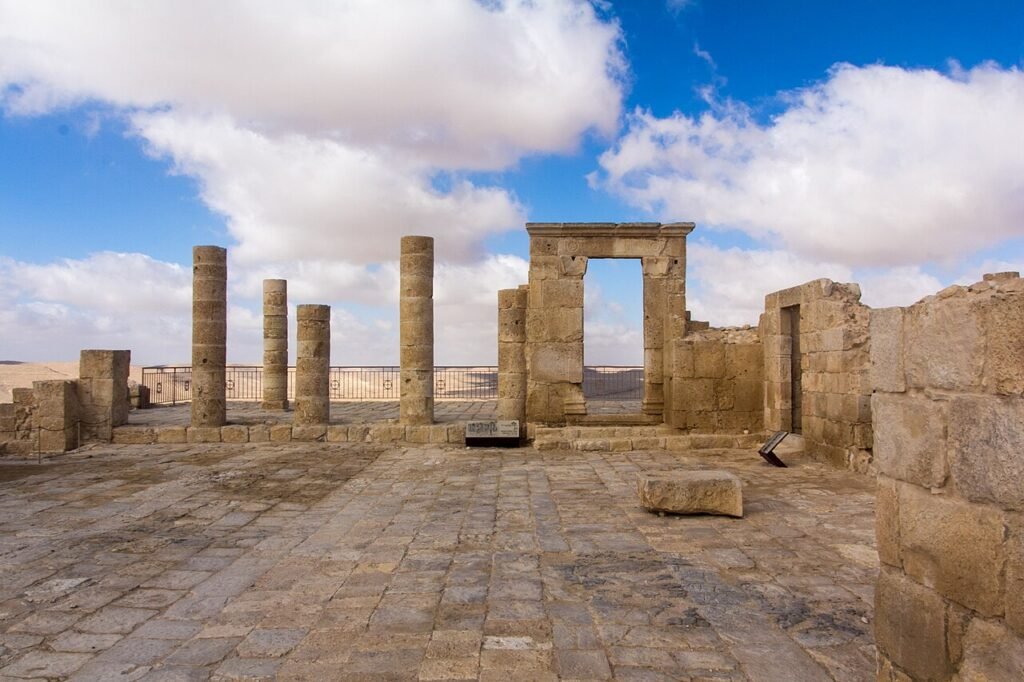
Located on the acropolis of the ancient city, The Temple of Oboda represents one of Avdat’s most significant religious monuments, dedicated to the deified Nabatean king Obodas I. Built in 9 BCE during the reign of Obodas II using hard limestone construction, this temple served as the eternal resting place and center of worship for the king’s cult. The building measures 14 by 11 meters overall and sits adjacent to two other important structures: a Christian chapel and a second temple known as the western temple.
The temple follows a traditional tripartite structure consisting of a porch, hall, and adytum divided into four distinct rooms. Worshipers would enter through the south-facing porch, which contains two compartments separated by a 60-centimeter wall, then proceed northward through the 8-meter oblong hall (now covered by talus) to reach the sacred adytum rooms. The smaller eastern room measures 3 by 4 meters, while the larger western room spans 5 by 4 meters.
The temple’s most fascinating feature is its worship arrangement, where devotees would turn to face south toward carved niches containing deity images. The western room housed two niches believed to have held images of the Nabatean gods Allat and Dushura, while the eastern room contained a single larger niche where the deified image of Obodas the King was venerated. This sophisticated religious complex demonstrates the important role of ruler worship in Nabatean culture and the architectural sophistication achieved in desert temple construction.
Visiting Avdat National Park: Practical Information
Avdat National Park is located along Route 40 in the central Negev Desert, approximately 65 kilometers south of Beersheba. The official park website provides current opening hours and admission fees, which vary by season. The site includes well-marked trails, informational signage in multiple languages, and shaded rest areas for visitor comfort.
The best time to visit is during cooler months from October through April, when desert temperatures are more comfortable for extended outdoor exploration. Early morning visits offer the advantage of cooler temperatures and optimal lighting for photography of the ancient ruins against the desert landscape.
Sources and Further Reading
- Avdat National Park – Israel Nature and Parks Authority — Official website with visitor information, opening hours, and site features
- En Avdat National Park Research Guide — Official research publication by the Israel Nature and Parks Authority featuring geological and environmental studies of the En Avdat canyon system, with contributions from Ben-Gurion University Desert Research Institute
- Avdat – Wikipedia — Comprehensive historical overview and archaeological findings
- Tourist Tip #104 Avdat National Park — Haaretz article covering Avdat as a UNESCO World Heritage Site, featuring information about the Nabataean water-harvesting methods that inspired Ben-Gurion and details about the ancient ruins including temples and churches
- Israel’s Top 10 National Parks — Times of Israel blog post featuring Ein Avdat National Park as one of Israel’s top 10 parks, describing the canyon landscape and hiking opportunities in the Negev Desert
- Letters from Israel – Our excellent adventure in the Negev — Jewish Standard article describing a visit to Avdat National Park, mentioning it as one of four Negev UNESCO World Heritage sites with Byzantine churches, Nabatean residences, and one of Israel’s oldest wine presses
Nearby Sites
- National Park Tel Hazor: Ancient Canaanite and Israelite city featuring massive earthen ramparts and Solomon’s gate.
- Qumran National Park: Archaeological site where the Dead Sea Scrolls were discovered, located near the Dead Sea.
- Maresha (Beit Guvrin-Maresha National Park): Hellenistic city with extensive underground cave systems and burial complexes.
- Beit Shearim National Park: Important Jewish burial site from the Roman period with decorated catacombs.
- En Avdat National Park: Canyon nature reserve featuring hiking trails, springs, and desert wildlife habitat.
- Ben-Gurion’s Grave: Final resting place of Israel’s first Prime Minister, located nearby with desert views.