
The Great Mosque of Ramla: A Crusader Church Turned Mosque
The Great Mosque of Ramla, also known as the El-Omari Mosque was originally constructed as a Christian church by the Crusaders in the 12th century, and was later transformed into a mosque under Mamluk rule. Today, it remains one of the few complete Crusader structures in Israel.
Location
The Great Mosque is situated in Ramla, a city in Israel’s Central District. Specifically, it lies within the old city area, adjacent to the bustling Ramla Market.



The History of the Great Mosque of Ramla
Ramla holds the distinction of being the only city in Palestine established by the Arabs, founded between 715 and 717 CE by the Umayyad Caliph Sulayman ibn Abd al-Malik. Over the centuries, the city came under the dominion of various empires, including the Abbasids, Fatimids, Crusaders, Mamluks, Ottomans, and the British.
During the Crusader period, Ramla emerged as a significant urban center and a vital stopover for pilgrims en route to Jerusalem. The Crusaders, upon capturing the city, constructed a grand basilica around 1150 CE, which now serves as the Great Mosque. This church was a prominent example of Crusader architecture in the Holy Land.
In 1260, the Mamluks regained control of Ramla. By 1266 or 1268 CE, under Sultan Baybars, the Crusader church was converted into a mosque. This transformation involved the addition of Islamic architectural elements, including a mihrab (prayer niche) and a minaret. Inscriptions within the mosque attest to these Mamluk-era renovations, with notable dedications from 1298 and 1314 CE commemorating the construction of the minaret and other modifications.
Architectural Features
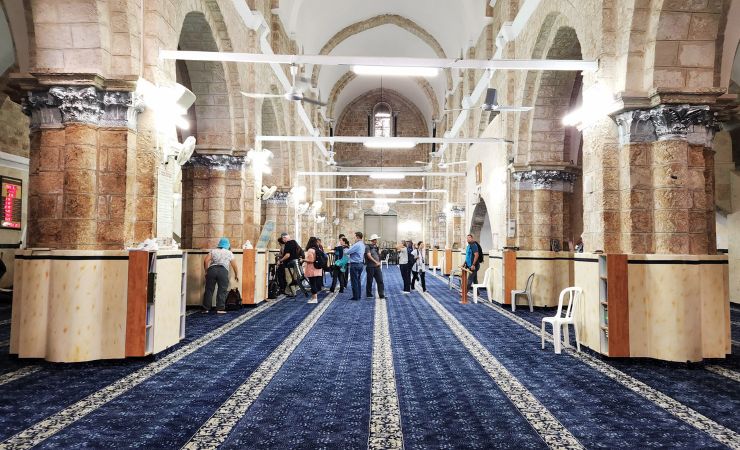
The Great Mosque of Ramla is architecturally significant, showcasing a blend of Crusader and Islamic design elements. Its structure adheres to the classical basilica layout, featuring:
Three Parallel Halls: Comprising a central nave flanked by two aisles, characteristic of Crusader church design.
Mihrab: An Islamic prayer niche added during the mosque’s conversion, oriented towards Mecca.
Former Apse: Located on the eastern wall, this large niche originally served as the church’s apse, facing east towards Nazareth.
Minbar: A pulpit situated next to the mihrab, from which sermons are delivered during Friday prayers.
Women’s Prayer Gallery: Positioned at the rear of the mosque, providing a separate space for female worshippers.
Carpeted Floor: The mosque’s floor is covered with carpets marked to indicate individual prayer spaces.
Purification Facility: Located in the courtyard, this facility allows worshippers to perform ablutions before prayer.
Minaret: Constructed in 1314 CE, the minaret stands as a prominent feature, used for the call to prayer.
Additional features at the Great Mosque of Ramla Arabic include inscriptions, such as a quote from the Quran (Sura 9, verse 18), and declarations related to Sultan Baybars and subsequent Mamluk renovations. Notably, the mosque’s columns bear chipping marks with letters, indicative of Crusader stonemasons’ craftsmanship.
Additional Information
- First half of the 8th century CE (circa 705-715): Ramla is founded by the Umayyad Caliph Sulayman ibn Abd al-Malik as the capital of Jund Filastin (the district of Palestine) in Bilad al-Sham. It replaces the nearby city of Lydda as the administrative center.
- 1099-1187: Ramla is under Crusader rule. The Christians call the city Rama, Ramata, or Rames and establish a Bishop (Episcopus Ramantis).
- Around 1150: The Crusaders build a large and magnificent church in Ramla, which remains standing today and is a beautiful example of Crusader architecture. This church is later converted into the Great Mosque.
- 1260: Mamluk ruler Baybars conquers the Holy Land, including Ramla. The Mamluks expel the Christians from the Cathedral of Saint John the Baptist (the Crusader church) and convert the building into a mosque, now known as the Great Mosque or al-Jami al-Kabir. Changes include adding a minbar and mihrab. Inscriptions are placed over the northern lintels, commemorating Baybars (western) and Sultan Qatbugha (eastern), dated 1268 and 1298 respectively.
- 1314: The minaret of the Great Mosque is repaired, as indicated by a Mamluk inscription above the entrance gate.
Nearby Sites
- Pool of Arches: An 8th-century underground water cistern where visitors can enjoy a boat ride amidst ancient arches.
- White Tower: A 13th-century Mamluk minaret offering panoramic views of the city from its summit.
-
British War Cemetery: The resting place of thousands of World War I and II soldiers.
- Franciscan Church and Hospice: Also known as the Hospice of St. Nicodemus and St. Joseph of Arimathea.