Beit Alpha Synagogue: A Mosaic Masterpiece Underfoot
Beit Alpha Synagogue is a small archaeological site in northern Israel, known mainly for one thing: its mosaic floor. Built in the sixth century, this synagogue sat quietly in the corner of a farming village at the foot of Mount Gilboa. It is famous for its well-preserved, stunning mosaic floor.

Location of the Beit Alpha Synagogue
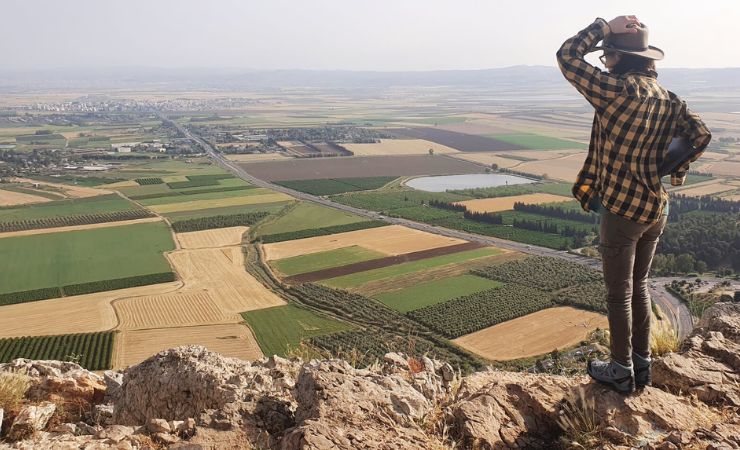
The Beit Alpha Synagogue National Park sits in the Harod Valley, located between Kibbutz Beit Alpha and Kibbutz Hefzi‑Bah. It is is just a 10‑minute drive from the archaeological treasures of Beit She’an.
The History of the Synagogue
The ancient synagogue of Beit Alpha is dated to the Byzantine period. It was part of a small Roman/Byzantine agricultural village near the Roman road from Scythopolis (Beit She’an) to Megiddo/Legion and Caesarea. The synagogue structure itself was built at the end of the 5th century, and its mosaic floor was commissioned at the beginning of the 6th century, during the reign of Byzantine Emperor Justin I (reigned 518-527 AD). A hoard of Byzantine coins, dated to the early 4th century, was found hidden in a Genizah (ritual archive place) under the apse.
The Beit Alpha Synagogue continued to function under Muslim control but was destroyed in the massive earthquake of 749 AD. It remained in ruins until its rediscovery in the 20th century.



The Mosaic Floor: Three Panels, Many Layers
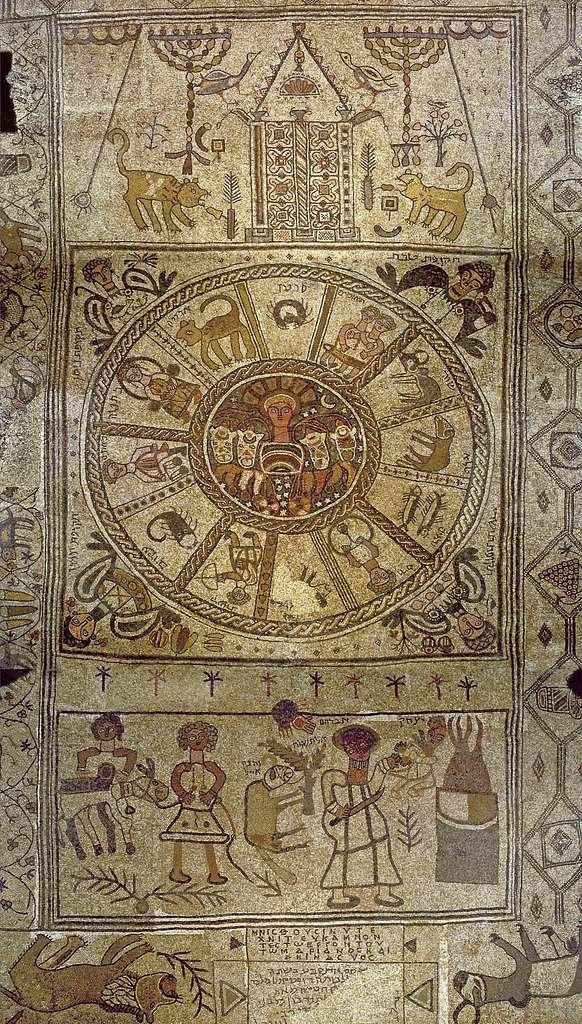
The most striking feature of Beit Alpha is its well-preserved mosaic floor, made by two artists named Marianos and Hanina. It’s made up of three large panels running down the center of the synagogue, surrounded by patterns and small images of animals, plants, and daily life.
The Binding of Isaac (Northern Panel)
This panel shows one of the most famous stories in the Torah—Abraham preparing to sacrifice his son Isaac (Genesis 22).
Abraham stands with a knife raised.
Isaac lies on an altar.
A hand, symbolizing God, reaches down with the Hebrew phrase “al tishlach” (“do not stretch out your hand”).
A ram, caught in a bush, appears nearby as a substitute for Isaac.
Two servants and a donkey stand off to the side, just like in the biblical account.
The figures are labeled in Hebrew, and the quotes come directly from the Torah.
The Zodiac Wheel (Central Panel)
This panel feels different. At its center is Helios, the sun god, riding a chariot. Around him are the twelve signs of the zodiac, all labeled in Hebrew. In the corners, four female figures represent the seasons, each with symbols of agricultural work.
Why is this in a synagogue? Scholars have suggested a few reasons:
It may have served as a visual calendar, helping people keep track of festivals.
It could reflect how Jewish communities adopted common artistic themes of the time without focusing on their original meanings.
Some believe it’s connected to God’s promise to Abraham that his descendants would be “as numerous as the stars.”
The Torah Shrine (Southern Panel)
This panel sits closest to the place where the Torah Ark once stood in the synagogue.
It shows a decorated ark under a gabled roof, flanked by birds (either ostriches or peacocks).
A lamp hangs above it.
Menorahs stand on each side, along with a shofar, lulav, etrog, and incense shovel—objects tied to Jewish ritual and holidays.
Two lions guard the base, and drawn curtains frame the whole scene.
Significance and Interpretations
The Beit Alpha Synagogue mosaic is a powerful example of Jewish art in late antiquity, showcasing a deep engagement with religion and community through visual imagery. It challenges the perception that ancient Judaism was strictly aniconic (lacking images of human figures), demonstrating that figural art played a significant part in how some Jewish communities engaged with their sacred spaces. The dedicatory inscriptions highlight the community’s financial contributions and active interest in this type of art within their synagogues.
The combination of clear Jewish and pagan symbols, such as the Zodiac and Helios, within the same sacred space, remains a subject of scholarly debate. While some scholars argue for a symbolic or religious meaning, others view them as purely decorative elements whose pagan origins may have been forgotten. Hannah Tandy’s research argues that the artists and commissioners purposefully used the zodiac to enhance the themes of obedience, responsibility, and reward to God, connecting it to the story of Abraham and Isaac and the promise of God’s blessings.
Additional Information
1st century AD (approx.): The Roman/Byzantine agricultural village of Beit-Alpha is established.
Early 4th century AD: A hoard of Byzantine coins is hidden in a Genizah (ritual archive place) under the apse of the Beit Alpha synagogue.
4th century AD: The Peutinger map, based on a Roman map, marks the village of Beit-Alpha.
End of 5th century AD: The Beit Alpha synagogue structure is built.
Beginning of 6th century AD (518-527 AD): During the reign of Byzantine Emperor Justin I, the magnificent mosaic floor of the Beit Alpha synagogue is commissioned and laid. The artists, Marianos and his son Hanina, are also known mosaic craftsmen from Beit She’an.
749 AD: The Beit Alpha synagogue, still functioning under Muslim control, is destroyed in a massive earthquake that levels many towns and cities in the region. The area subsequently turns into a large swamp due to unrepaired water channels and irrigation.
1866-1877: The site, appearing as “Kh. Beit Ilfa,” is examined during the PEF survey by Wilson, Conder, and Kitchener, who describe foundations of buildings and walls, including well-dressed stones and ancient sarcophagi.
1878: The PEF survey map shows “Kh. Beit Ilfa” near ancient roads.
1922: Two Kibbutz settlements are established around the ruins of the Roman village: Kibbutz Beit-Alpha (named after the ruins) to the east, and Kibbutz Hefzi-bah (named after Jerusalem) to the west.
1928: Kibbutz Hefziba members accidentally discover the extensive mosaic floors of the Beit Alpha synagogue during irrigation construction for a new dining hall.
Early 1929: Archaeological excavations of the Beit Alpha synagogue begin under the auspices of the Hebrew University of Jerusalem, led by Eleazar Sukenik.
Early 1930: A structure is built over the synagogue with British Mandate government funding to protect the mosaic.
October 1960: A new building is inaugurated over the mosaic, with surrounding lawns, restrooms, and a cafeteria.
1962: A secondary round of excavations, sponsored by the Israel Antiquities Authority, further explores residential structures around the synagogue.
October 1965: A section of the mosaic depicting a shofar goes missing.
Nearby Sites
- Beit She’an National Park (~10 min east): A sprawling Roman‑Byzantine city with a theater, baths, and colonnaded streets.
- Tel Megiddo (~30 km northwest): Archaeological layers from Bronze Age to Crusader—legendary Armageddon scenery.
- Kochav HaYarden (Belvoir Fortress) (~20 km north): A Crusader-era hilltop castle with sweeping views of the Jordan Valley.
- Mount Gilboa: A favorite for scenic hikes and panoramic viewpoints over Jezreel and Jordan Valleys.