Church of the Beatitudes: Octagonal Oasis of Peace
The Church of Beatitudes is a biblical site that radiates a serene ambiance, an echo of the peace preached by Jesus Christ during his Sermon on the Mount.
Location
The Church of the Beatitudes rests about 150 meters above the hushed northern shores of the Sea of Galilee in Israel. It overlooks the vast expanse of the tranquil sea.
The Church of Beatitudes: Biblical Context
The Church of Beatitudes signifies a pivotal moment in Christian history. Tradition points to this peaceful hill as the location where Jesus Christ delivered his famed Sermon on the Mount, recorded in the Gospel of Matthew.
These verses depict Jesus teaching a crowd of followers on a mountainside. His sermon covers a range of moral and ethical issues, but it begins with the “Beatitudes” – a set of eight blessings that outline a moral code for personal conduct and a blueprint for a life centered around love, peace, and righteousness.
“And seeing the multitudes, He went up on a mountain, and when He was seated His disciples came to Him. Then He opened His mouth and taught them, saying:
- Blessed are the poor in spirit, For theirs is the kingdom of heaven.
- Blessed are those who mourn, For they shall be comforted.
- Blessed are the meek, For they shall inherit the earth.
- Blessed are those who hunger and thirst for righteousness, For they shall be filled.
- Blessed are the merciful, For they shall obtain mercy.
- Blessed are the pure in heart, For they shall see God.
- Blessed are the peacemakers, For they shall be called sons of God.
- Blessed are those who are persecuted for righteousness’ sake, For theirs is the kingdom of heaven.
The Architectural Brilliance of Antonio Barluzzi
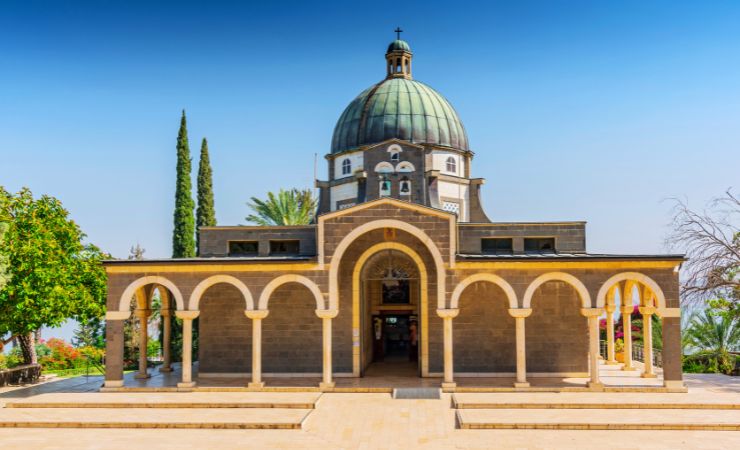
The Church of Beatitudes owes its unique design to the visionary Italian architect, Antonio Barluzzi. Barluzzi designed the Church of the Beatitudes in the late 1930s. The church was completed in 1938. He modelled the church as an octagonal edifice, constructed primarily from local basalt stone and white stone, mirroring the eight Beatitudes preached by Jesus Christ in his Sermon on the Mount.
The Church of the Beatitudes is characterized by its distinctive octagonal floor plan, where each of the eight sides symbolizes one of the eight Beatitudes. This Neo-Byzantine style building features a dome that some describe as resembling an overturned boat.
Internal Structure and Design
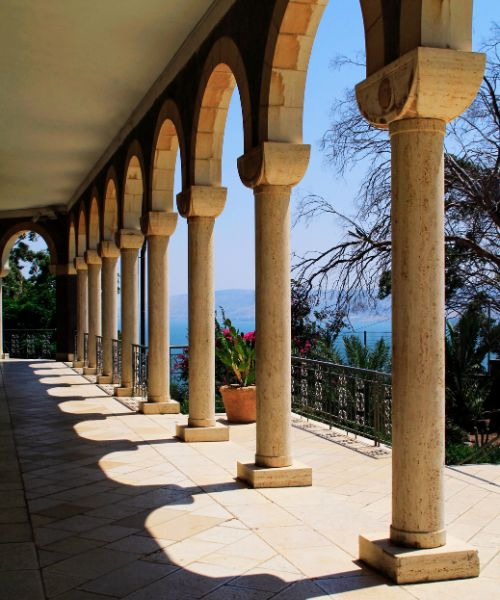
Inside, the church is designed to be light and airy, with large windows intentionally placed at eye level, allowing visitors to continuously absorb the incredible scenery and feel the spirit of the place.Visitors can see virtually all the places where Jesus lived and worked, including Capernaum, just 3km away. The cloister has nine arches on most sides, except for the northern side, which has seven arches with a central, taller, and wider arch leading to the entrance.
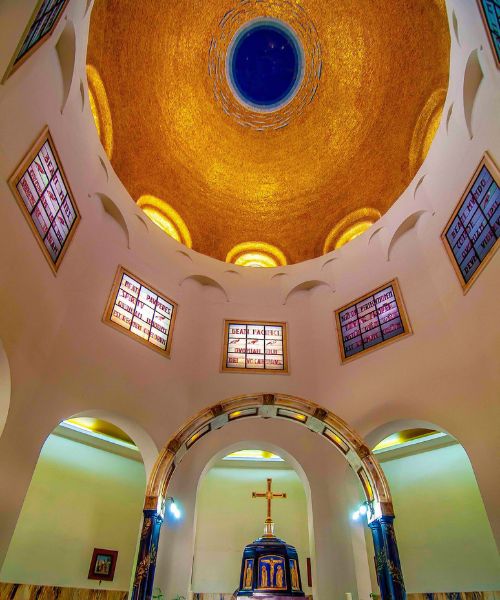
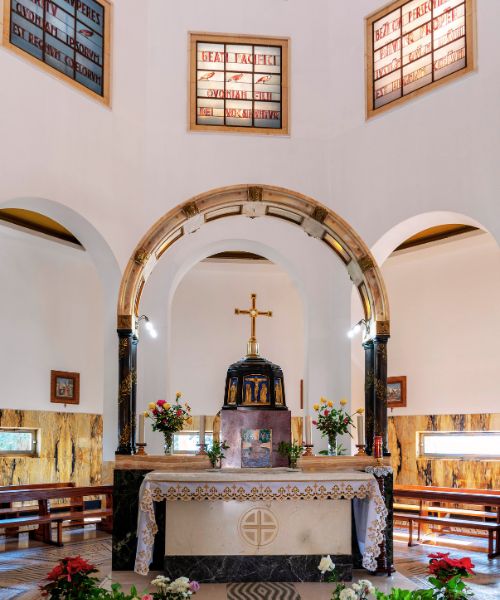
The lower interior walls are cased in marble veneer, and the dome is adorned with gold mosaic. Around the altar, the mosaic pavement depicts seven virtues: Justice, Prudence, Fortitude, Temperance, Faith, Hope, and Charity. Each of the eight Beatitudes is also inscribed in Latin in the upper windows.
The central dome, forms a focal point that invites the gaze upwards. It’s a stark contrast to the darker basalt stone, creating a visual interplay between the elements. The inner dome is adorned with representations of the four evangelists, their symbols etched intricately in the gold and blue mosaic. The internal surface of the dome, adorned with a radiant golden mosaic, is illuminated by a further eight windows situated at its base.
The church’s eight windows, crafted from vibrantly colored stained glass, each bear one of the eight “Blessed” verses in Latin. Encircling the altar on the church floor is a meticulously designed mosaic. Imbued within the mosaic pavement are symbols embodying the cardinal virtues of Justice, Prudence, Fortitude, and Temperance, along with the theological virtues of Faith, Hope, and Charity. Small windows allow the visitors to stay connected to the surrounding gardens.
External Gardens
The church is surrounded by lush, meticulously tended gardens with shaded paths and benches, providing ample space for quiet reflection. Three altars are also provided in the landscaped garden for group worship. These altars were recently moved closer to the sisters’ living quarters and guesthouse due to settlers encroaching on the lands near the church complex, highlighting the ongoing political dynamics in the Holy Land. The area has also experienced challenges, such as a recent arson attack that scorched trees but fortunately left the church undamaged, serving as a “stark reminder of how difficult things can be in the Holy Land for Christians”.
Archeological findings at the Church of Beatitudes
There were no archeological findings on the current church grounds, but in the vicinity of the present-day church, remnants of a 4th-century Byzantine church that was probably in use up the 7th century were found.
Additional Information
4th Century CE: A Byzantine church is erected near the traditional site of the Sermon on the Mount. This church served the area until the 7th century, with its ruins later discovered downhill from the current Church of the Beatitudes.
7th Century CE: The original Byzantine church, built in the 4th century, is no longer in use.
1930s: Franciscan Sisters of the Immaculate Heart of Mary request assistance for a new church. The nuns seek help from Italian dictator Benito Mussolini to construct a new church on the Mount of Beatitudes. Mussolini provides financial support for the construction, seeking to gain support for his regime from the Church. Antonio Barluzzi is commissioned as the architect to design the Church of the Beatitudes.
1936-1938: Construction of the Church of the Beatitudes takes place. The elegant octagonal building with colonnaded cloisters is built on the Mount of Beatitudes.
March 2000: Pope John Paul II celebrates Mass at the Church of the Beatitudes. He delivers a sermon to a large crowd assembled on the hillside, echoing Jesus’s original teaching.
Nearby Sites
- Church of the Multiplication, Tabgha: The Church of the Multiplication is traditionally believed to be the site where Jesus performed the miracle of feeding the 5,000 with five loaves and two fishes.
- Capernaum: Often referred to as “Jesus’ Own City,” Capernaum hosts impressive archaeological sites, including a well-preserved synagogue and the House of Saint Peter.
- Korazim (Corazim): Once a prosperous town, Korazim is now an archaeological site that offers a glimpse into the past. It is one of the “cursed” cities. The ruins, including an ancient synagogue.
- Magdala: Magdala is the home of Mary Magdalene. Excavations in Magdala have revealed a well-preserved first-century synagogue and a complete city infrastructure.
- ‘Jesus Boat‘ in Genosar: Discovered in the Sea of Galilee, the boat dates back to the 1st century AD, coinciding with the time when Jesus might have traversed these waters.
- Domus Galilaeae: A Christian site beckons seekers of spiritual enlightenment to its tranquil retreat.