
Masada National Park preserves an ancient palace-fortress complex built by King Herod the Great between 37-31 BCE on an isolated plateau 1,300 feet above the Dead Sea. The site became globally significant as the location of the final siege of the First Jewish Revolt against Rome in 73 CE, when Roman forces built massive earthworks to breach the mountain stronghold.
Location
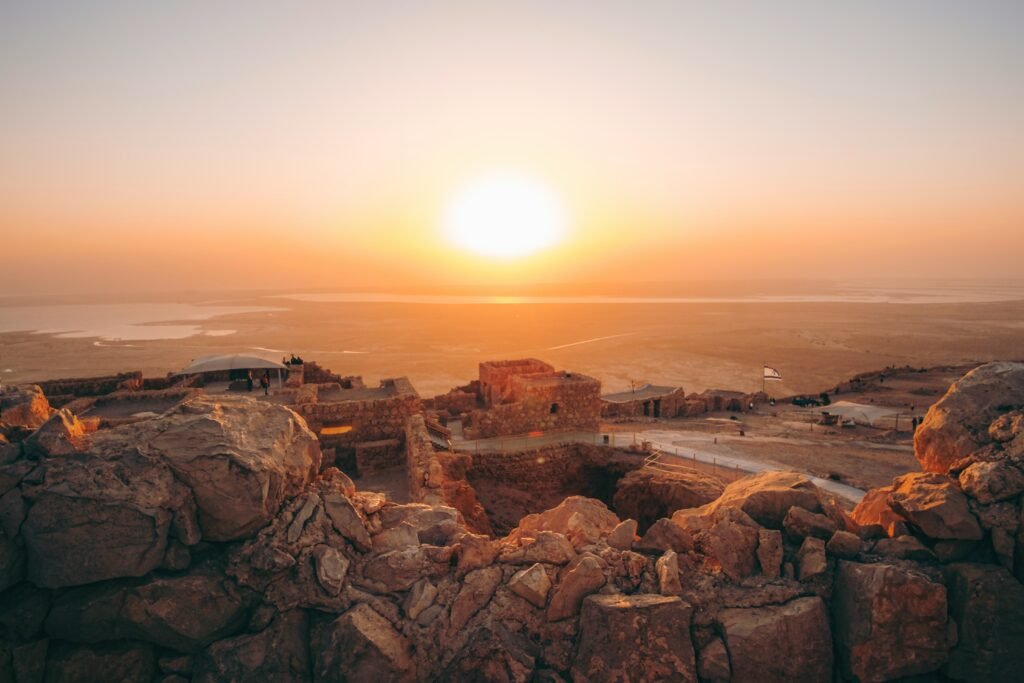
The fortress sits on a natural plateau in the Dead Sea desert, rising dramatically from the eastern edge of the Judean Desert. Located approximately 20 kilometers south of Ein Gedi, the site overlooks the Dead Sea and provides commanding views across the desert landscape to Jordan. The mountain’s sheer cliffs and isolated position made it an ideal defensive position, accessible only by narrow, treacherous paths carved into the rock face.
The name Masada derives from the Hebrew word metzada, meaning fortress or stronghold, reflecting its strategic military importance. The plateau measures approximately 650 meters in length and 300 meters in width at its summit, creating a natural citadel that could accommodate substantial buildings and defensive installations.
Historical Background
Herod the Great transformed this natural stronghold into a luxurious palace-fortress complex, complete with elaborate residences, administrative buildings, and sophisticated water collection systems. The construction represented the pinnacle of Roman engineering adapted to the harsh desert environment, featuring innovative architectural solutions and imported luxury materials.
Following Herod’s death in 4 BCE, Masada remained a royal fortress under Roman administration until Jewish rebels captured it during the First Jewish Revolt in 66 CE. These rebels, led by Eleazar ben Ya’ir, held the fortress for seven years, using it as a base for raids against Roman positions throughout the region. The rebels transformed Herod’s palace rooms into living quarters and established religious facilities, including one of the earliest known synagogues from the Second Temple period.
The Roman Tenth Legion, under the command of Flavius Silva, arrived to besiege the fortress in 73 CE. The Romans constructed eight military camps around the base of the mountain and built a massive assault ramp on the western side. Recent archaeological research by Tel Aviv University suggests the siege lasted only weeks, not years as traditionally believed, demonstrating the overwhelming efficiency of Roman military engineering.
Archaeological Discoveries
Systematic excavations led by Yigael Yadin between 1963-1965 revealed the extent of both Herodian construction and the later Jewish revolt period. The archaeological team uncovered luxury items from across the Roman Empire, including wine jars from Italy and elaborate frescoes decorated in the Roman style. These discoveries confirmed historical accounts of Herod’s extravagant building projects and his access to international trade networks.
Among the most significant finds were fragments of biblical scrolls discovered in the synagogue area, representing some of the oldest known copies of Hebrew scriptures outside the Dead Sea Scrolls collection. The archaeologists also uncovered hundreds of pottery shards inscribed with names, which some scholars interpret as lots cast by the defenders during their final moments, though this interpretation remains debated.
The excavations revealed sophisticated engineering solutions to desert survival, including an intricate water collection system that channeled rainwater from nearby wadis through channels and aqueducts to massive storage cisterns carved into the rock. Evidence of food storage, weapons manufacturing, and daily life during the revolt period provided unprecedented insight into how the Jewish rebels organized their resistance.
Conservation work continues today, with restoration of ancient frescoes and ongoing research into the site’s construction techniques. The archaeological evidence contributed to Masada’s designation as a UNESCO World Heritage Site in 2001, recognizing its outstanding universal value for understanding ancient engineering and the Jewish revolt period.
Inside Masada National Park: What the Excavations Revealed
The archaeological remains at Masada demonstrate both the luxury of Herodian palace life and the ingenuity of Roman military engineering. The site preserves structures spanning nearly a century of occupation, from Herod’s original construction through the Jewish revolt and Roman siege. Visitors can examine these layers of history while enjoying panoramic views across the Dead Sea desert.
The most impressive architectural achievement lies at the fortress’s northern edge, where Herod’s architects defied natural limitations to create a palace of unprecedented ambition.
Northern Palace — Herod’s most spectacular architectural achievement cascades down the northern cliff face in three distinct levels connected by staircases carved into the living rock. The upper terrace housed royal residential quarters with elaborate mosaic floors and painted plaster walls imitating marble. The middle terrace served as a circular pavilion for entertainment, while the lower terrace featured a bathhouse complex with hot, warm, and cold rooms in the Roman style. The engineering required to construct these terraces on the cliff face represents one of the most ambitious building projects in the ancient world.
Roman Siege Ramp — The massive earthen ramp constructed by the Roman Tenth Legion remains the most complete example of Roman siege engineering in existence. Rising 100 meters from the desert floor to breach the western wall, the ramp required moving thousands of tons of earth and stone. Archaeological examination of the ramp reveals the systematic approach Roman engineers used to overcome seemingly impossible defensive positions. Visitors can walk along portions of the ramp and examine the siege wall that the Romans built to contain the fortress.
Ancient Synagogue — Located in the western section of the site, this structure represents one of the earliest positively identified synagogues from the Second Temple period. The building features stone benches arranged around the walls and a genizah (storage area) where fragments of biblical scrolls were discovered, including portions of Deuteronomy and Ezekiel. The synagogue’s orientation and architectural features provide crucial evidence for understanding Jewish religious practices during the first century CE.
Water Cisterns — Twelve massive cisterns carved into the northern cliff demonstrate Herod’s solution to desert survival. These chambers could store 40,000 cubic meters of water, collected through an ingenious system of dams and channels that captured flash flood waters from seasonal rains. The largest cistern measures 45 meters in length and stands as tall as a four-story building. Visitors can enter several cisterns to appreciate the scale of this engineering achievement and understand how the fortress could sustain lengthy sieges.
Storehouses — Fifteen long storerooms near the site’s center contained provisions for the royal court and later served the Jewish rebels during their occupation. Archaeological excavations revealed remains of wine, oil, grain, and dates stored in large jars, some bearing stamps indicating their origins across the Roman Empire. The storehouses also contained weapons and luxury items, demonstrating both the wealth of Herod’s court and the rebels’ ability to maintain supplies during their seven-year occupation.
Roman Military Camps — Eight Roman military camps surrounding the fortress base remain visible from the summit, outlining the complete siege system employed by the Tenth Legion. These camps housed approximately 15,000 Roman soldiers and their support personnel during the siege operations. The camps’ rectangular layouts, typical of Roman military engineering, demonstrate how the Romans systematically isolated Masada before launching their final assault. Recent research suggests the efficiency of this siege system allowed the Romans to complete their conquest much more quickly than previously believed.
Archaeology Findings and Josephus Compared
Modern archaeological research has revealed significant discrepancies between the historical account provided by Flavius Josephus and the physical evidence uncovered at Masada. While Josephus remains our primary written source for the siege events, excavations have exposed important gaps and inaccuracies in his narrative that continue to shape scholarly debates about the site’s history.
Hasmonean Period Buildings — Despite Josephus’s claims about earlier Hasmonean construction at Masada, Yadin’s excavations could detect no architectural remains definitively dated to this period. The only firmly dated Hasmonean artifacts were numerous coins of Alexander Jannaeus. While researchers have speculated that portions of the Western Palace complex could be Hasmonean based on similarities to structures at Jericho, their excavators found no archaeological evidence to support this theory.
Palace Complex Descriptions — Scholar Shaye Cohen notes that archaeology shows Josephus’s account to be “incomplete and inaccurate.” While Josephus describes only one palace, excavations revealed two distinct palace structures. His description of the Northern Palace contains several architectural inaccuracies, and he provides exaggerated measurements for wall and tower heights throughout the fortress. These discrepancies suggest Josephus may have relied on secondhand accounts rather than direct observation.
Mass Suicide Evidence — The archaeological evidence for Josephus’s famous account of mass suicide by 960 Sicarii rebels remains ambiguous and is rejected entirely by some scholars. The discovery of skeletons in caves and evidence of numerous separate fires contradicts Josephus’s narrative of coordinated self-destruction. Historian Eric Cline suggests Josephus may have projected his own experience during the Siege of Yodfat, where he and another soldier chose surrender over mutual killing, onto the Masada events to create a more heroic narrative.
Visiting Masada National Park: Practical Information
Masada National Park operates year-round with seasonal hour variations, typically opening before sunrise to allow visitors to witness dawn from the summit. The site includes a modern museum displaying artifacts from the excavations and offering detailed explanations of the archaeological findings. Cable car service provides access to the summit for those unable to hike the ancient paths, while the Snake Path trail offers a challenging but rewarding climbing experience. The visitor center features a detailed scale model of the fortress and screening of an orientation film explaining the site’s historical significance.
Nearby Sites
- Qumran National Park: Archaeological site where the Dead Sea Scrolls were discovered, providing insight into Second Temple period Jewish communities.
- Maresha (Beit Guvrin-Maresha National Park): Extensive underground cave systems and Hellenistic city remains in the Judean foothills.
- National Park Tel Hazor: Major Canaanite and Israelite city remains in northern Israel, another UNESCO World Heritage site.
- Ein Gedi Nature Reserve: Desert oasis with waterfalls and hiking trails, located north of Masada along the Dead Sea shore.
- Dead Sea Beaches: Mineral-rich waters and mud treatments at the lowest point on Earth’s surface.