Bethsaida and Bethesda are two distinct biblical sites that pilgrims frequently confuse due to their similar names. Bethsaida was a fishing village on the Sea of Galilee where Jesus performed miracles and several apostles originated. Bethesda was a healing pool in Jerusalem where Jesus healed a paralyzed man. The sites differ in location, purpose, and historical significance.
Two Names, Two Sites, One Very Common Mistake
Bethsaida and Bethesda. Say them aloud and the confusion is immediate, they are one consonant apart, and that one letter has been causing mix-ups among pilgrims, scholars, and travellers for centuries. Search for either name online and you will find articles, forum posts, and tour itineraries that use them interchangeably, placing the apostles’ hometown in Jerusalem or sending visitors to the Sea of Galilee to look for a pool. They are not the same place, they are not near each other, and they tell entirely different stories.
Bethsaida was a fishing town on the northern shore of the Sea of Galilee in the Galilee region. It was the hometown of three of Jesus’s apostles, Peter, Andrew, and Philip and the site of multiple miracles recorded in the Gospels. Bethesda was a pool complex in Jerusalem, about 120 kilometres to the south, where Jesus healed a man who had been unable to walk for 38 years. One site is about geography, community, and the everyday world of first-century Galilean fishermen. The other is about a moment of radical intervention at the gates of the Temple city.
Understanding the difference between Bethsaida and Bethesda does more than resolve a naming puzzle. It opens up two of the most layered and archaeologically significant sites in the entire biblical landscape of Israel, each with a distinct character, a distinct story, and a distinct reason to visit.
Here is a quick table that compares the two. Detailed information follows:
| Parameter | Bethsaida | Bethesda |
|---|---|---|
| Name meaning | House of the fisherman (Aramaic: Beth-tsaida) | House of mercy or house of flowing waters (Aramaic: Beth-hesda) |
| Location | Northern shore of the Sea of Galilee, northern Israel | Muslim Quarter, Old City of Jerusalem |
| Type of site | Ancient fishing town; multi-period archaeological tel | Twin-pool water complex; sacred healing site |
| Biblical significance | Hometown of three apostles; site of miracles and Jesus’s reproach | Where Jesus healed a paralysed man; central to the Sabbath conflict in John’s Gospel |
| Key New Testament events | Feeding of the five thousand; healing of a blind man (Mark 8:22–26) | Healing of the man ill for 38 years (John 5:2–15) |
| Who is associated with it | Peter, Andrew, Philip; Philip the Tetrarch (rebuilt it as Julias) | The unnamed paralysed man; the Pharisees who challenged Jesus |
| Archaeological status | Active excavation since 1987; Iron Age and Roman remains confirmed | Fully excavated; twin-pool layout matches John’s description exactly |
| What visitors see today | City gate, basalt ruins, fisherman’s house, national park trails | Excavated pools, Byzantine church foundations, Crusader chapel, St. Anne’s Church |
Why the Names Sound So Similar
The resemblance between Bethsaida and Bethesda is not coincidence. Both names derive from Aramaic, the everyday language of Jewish Palestine in the first century. “Beth” (בֵּית) means “house” in both Hebrew and Aramaic and appears in dozens of place names across the region: Bethlehem (house of bread), Bethel (house of God), Beth She’an (house of security). The second syllable is where the two names diverge. “Saida” (צַיְדָא) means fishing or hunter Bethsaida is “house of the fisherman.” “Hesda” or “Hesda” (חֶסְדָּא) relates to mercy or grace — Bethesda may mean “house of mercy” or possibly “house of the flowing waters,” with scholars still debating the precise etymology.
In spoken Aramaic, both the names Bethsaida and Bethesda would have sounded similar enough to cause confusion even among native speakers encountering them for the first time in written Greek, which is how they appear in the Gospels. The Greek transcription flattens some of the distinctions between the original sounds. That phonetic overlap, combined with the fact that both sites are associated with miraculous healing by Jesus, has kept the confusion alive across every century since.
For pilgrims planning a visit to Israel, the practical consequence is simple: Bethsaida requires a full day trip to the Galilee, while Bethesda can be visited in an hour as part of a Jerusalem Old City walk. They belong to completely different itineraries and completely different landscapes, one rural and open, one dense and layered. Visiting both rewards a serious traveler with a sense of the full geographic range of Jesus’s ministry, from the fishing villages of the north to the political and religious center of the south.
Bethsaida: The Fishing Town of the Apostles
Location
Bethsaida sits in the far northeast of Israel, in the Jordan Valley just north of where the Jordan River empties into the Sea of Galilee. Today the site is protected within the Bethsaida National Park, near Kibbutz Ein Gev and the town of Katzrin in the Golan Heights. The ancient city itself was built on a basalt plateau what is now called Tel Beit Tzaida, or Et-Tell overlooking what was once the lakeshore. Over the past two thousand years, the shoreline receded and the river deposited enough sediment to shift the lake’s edge several kilometres south of the tel, which explains why the ruins appear to stand inland rather than on the water.
Biblical Context
Bethsaida appears by name in all four Gospels and is mentioned more frequently in the New Testament than almost any town outside Jerusalem. It was the hometown of Peter, Andrew, and Philip — three of the twelve apostles — and Jesus chose to perform some of his most significant miracles there. The feeding of the five thousand is associated with the area east of the town (Luke 9:10–17), and the healing of a blind man at Bethsaida is one of only two accounts in the Gospels of a miracle performed in stages (Mark 8:22–26).
Bethsaida also carries a shadow. Despite being a place of miracles, Jesus reproached it in the same breath as Chorazin for the unbelief of its inhabitants:
“Woe to you, Chorazin! Woe to you, Bethsaida! For if the miracles that were performed in you had been performed in Tyre and Sidon, they would have repented long ago in sackcloth and ashes.” — Matthew 11:21 (NIV)
That reproach is part of what makes Bethsaida so theologically complex: it was a place Jesus loved and visited repeatedly, home to people he knew by name, and yet it is recorded as a town that ultimately turned away. Corazim, reproached in the same passage, lies just a few kilometres to the west, and together the two sites frame a geography of missed opportunity in the Galilee ministry.
What Can Be Seen at Bethsaida
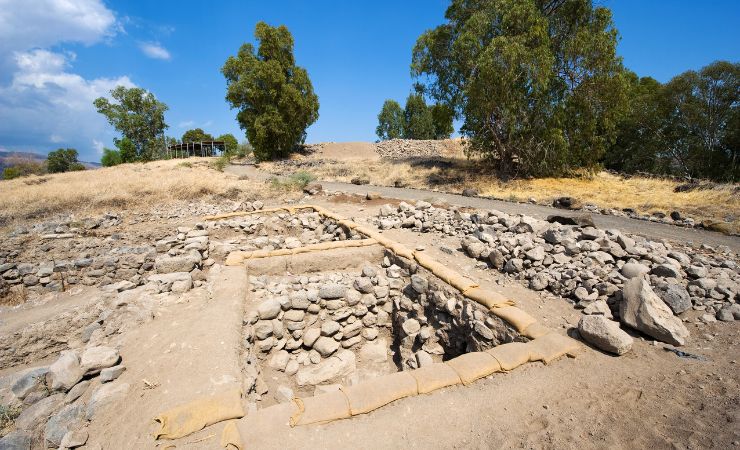
The excavations at Et-Tell have been ongoing since 1987 under the Bethsaida Excavations Project, a consortium of universities from North America, Europe, and Israel. What has emerged is a multi-period site occupied from the Early Bronze Age through the Hellenistic and Roman periods, with the Iron Age city-state of Geshur forming its most prominent chapter. Visitors walk through real excavations — not a reconstructed site — and the ruins are raw, open, and genuinely affecting.
The Iron Age City Gate is the site’s most dramatic feature: a massive four-chambered gate dating to the 10th or 9th century BCE, typical of the type described in biblical accounts of Israelite cities. Two basalt threshold blocks are still in place, and the width of the gateway — wide enough for a fully loaded cart — gives a tangible sense of how significant this city was in the period of the Israelite and Aramean kingdoms. The gate complex also includes a cultic standing stone, a basalt altar, and a carved stele of a moon goddess, discovered exactly where ancient worshippers would have left offerings.
The Fisherman’s House is a first-century residential structure excavated in the lower part of the site, and it is where the connection to the New Testament becomes most immediate. Found inside were lead net weights, a fishing hook, a stone anchor, and bronze needles used for repairing nets, the complete toolkit of a working Galilean fisherman. Whether this is literally the home of one of the apostles cannot be confirmed, but it belonged to someone doing exactly what the Gospels describe Peter, Andrew, and Philip doing when Jesus first called them.
The Roman-period remains at the site’s surface level include the ruins of a temple platform tentatively identified as a temple to Julia, daughter of Emperor Augustus, built by Philip the Tetrarch when he elevated Bethsaida to city status and renamed it Julias around 2 CE. This is the Bethsaida the apostles grew up in a small fishing village recently promoted to a Hellenised city, caught between Jewish tradition and Roman imperial culture.
The Bethsaida National Park surrounds the tel with nature trails, picnic areas, and views across the Jordan Valley toward the Golan Heights. The park is managed by the Israel Nature and Parks Authority, and entry includes access to the tel itself. The walk from the parking area to the summit takes approximately 15 minutes on a well-marked path.
Visiting Bethsaida: Practical Information
The Bethsaida National Park is open Sunday through Thursday and Saturday from 8:00 AM to 5:00 PM (4:00 PM in winter), and Friday 8:00 AM to 4:00 PM. Admission is included with the standard national park ticket (approximately 28 NIS for adults in 2026, with reductions for children and seniors). The site is located off Route 87 near Kibbutz Ein Gev; GPS coordinates 32.9155°N, 35.6366°E. There is no café on site, so bring water and food, particularly if combining with the Jesus Trail.
Bethesda: The Pool of Healing in Jerusalem
Location
The Pool of Bethesda is located in the Muslim Quarter of Jerusalem’s Old City, just inside Lions’ Gate and a short walk from the start of the Via Dolorosa. It sits within the grounds of the Crusader church of St. Anne, arguably the best-preserved Crusader church in the Holy Land and access to the pool excavations is included with entry to the church complex. Bethesda is approximately 120 kilometres south of Bethsaida, in an entirely different landscape: dense urban stone, the weight of the Temple Mount immediately to the south, and the layered archaeology of a city that has been continuously inhabited and rebuilt for three thousand years.
Biblical Context
The Pool of Bethesda appears in the Gospel of John in one of the most precisely located miracles in the New Testament. John identifies it as being near the Sheep Gate, describes its five colonnaded porches, and names it in Aramaic before giving the Greek translation — details that suggest either eyewitness knowledge or a source with firsthand familiarity with pre-70 CE Jerusalem:
“Now there is in Jerusalem near the Sheep Gate a pool, which in Aramaic is called Bethesda and which is surrounded by five covered colonnades. Here a great number of disabled people used to lie — the blind, the lame, the paralysed. One who was there had been an invalid for thirty-eight years.” — John 5:2–5 (NIV)
Jesus encounters this man, asks him whether he wants to get well, and heals him on the Sabbath — which becomes the immediate source of conflict with the religious authorities. The controversy is not about the miracle but about the day: healing on the Sabbath placed Jesus in direct tension with Pharisaic law, and John uses the Bethesda miracle as the opening of a sustained confrontation. The pool itself is described as a place where the sick waited for the periodic stirring of the water, believed to bring healing to whoever entered first, a detail that locates it within the popular healing traditions of first-century Jerusalem.
What Can Be Seen at Bethesda
The archaeological evidence for the Pool of Bethesda is among the strongest for any Gospel location. Excavations begun in the 19th century and extended through the 20th century have revealed a twin-basin pool complex whose dimensions and layout match John’s description with striking precision, including evidence for five portico structures. The site is today open-air, descending in terraced levels into the earth below the Crusader church, and visitors approach it along stone walkways that pass through centuries of stratified building history.
The Twin Pools are the centrepiece of the site two large rectangular basins separated by a central dam wall, with the northern pool used for collecting rainwater and the southern pool serving as a ritual bath (mikveh). The southern pool is the one most frequently associated with the healing narrative. At their greatest extent during the Second Temple period, the pools measured approximately 50 by 90 meters and 55 by 60 meters respectively , substantial engineering for a city managing its water supply in a region with no perennial river.
The Byzantine Church Ruins visible within the site date to the 5th century CE, when a large church was built over the southern pool to commemorate the miracle. Its three aisles, apse, and baptistery foundations are identifiable in the excavated layers, and mosaic fragments have been found in the soil nearby. The church was destroyed during the Persian invasion of 614 CE and never rebuilt to its original scale.
The Crusader Chapel, a small vaulted space descending into the pool area, was added in the 12th century when the Knights Hospitaller controlled the complex. It is rough-cut, low-ceilinged, and dramatically different in atmosphere from the bright white nave of St. Anne’s above it , a cave-like space that brings visitors physically close to the ancient water level.
St. Anne’s Church itself, while not the Pool of Bethesda, is the building that frames and preserves the site. Built by the Crusaders around 1138 CE and one of the very few Crusader structures never significantly altered or demolished, it is acoustically extraordinary, its stone barrel vaults produce a natural reverb that has made it a destination for choral groups and pilgrims who sing here specifically for the sound. The church is managed by the White Fathers (Missionaries of Africa).
The Crusader-era street running along the eastern edge of the complex preserves part of the layout of medieval Jerusalem, and finds from the excavations, ceramic vessels, coins, and stonework, are displayed in a small room adjacent to the pool descents. A National Geographic’s archaeological overview of Bethsaida provides context for the excavation history and its ongoing scholarly debates.
Visiting Bethesda: Practical Information
The St. Anne’s Church and Pool of Bethesda complex is open Monday through Saturday from 8:00 AM to 12:00 PM and 2:00 PM to 5:00 PM (closing at 6:00 PM in summer). It is closed on Sundays and Catholic feast days. Admission is approximately 5 NIS (2026). The entrance is just inside Lions’ Gate on the left; the address is 3 Nablus Road (Rehov HaNevi’im), Old City, Jerusalem. Modest dress is required, and bags are checked at the entrance.
Nearby Sites
- Capernaum: The Primary Base for Jesus’ Early Ministry: The town Jesus made his home base during the Galilee ministry, just a few kilometres west of Bethsaida along the northern shore of the Sea of Galilee.
- Corazim: The City that Jesus Reproached: Reproached by Jesus in the same breath as Bethsaida, Corazim’s black basalt ruins sit just 2 miles north of Capernaum on a hill above the lake.
- St. Anne’s Church Jerusalem: The Crusader church that preserves and frames the Pool of Bethesda excavations, known for its extraordinary acoustics and near-perfect state of preservation.
- The Pool of Siloam: A Pool from Both Temples: Jerusalem’s other great biblical pool, where Jesus healed a man born blind — a further example of pool-based healing miracles in the Gospels.
- The Church of the Primacy of Saint Peter: A church on the shore of the Sea of Galilee marking the site where the risen Jesus reinstated Peter — one of the apostles who grew up at Bethsaida.