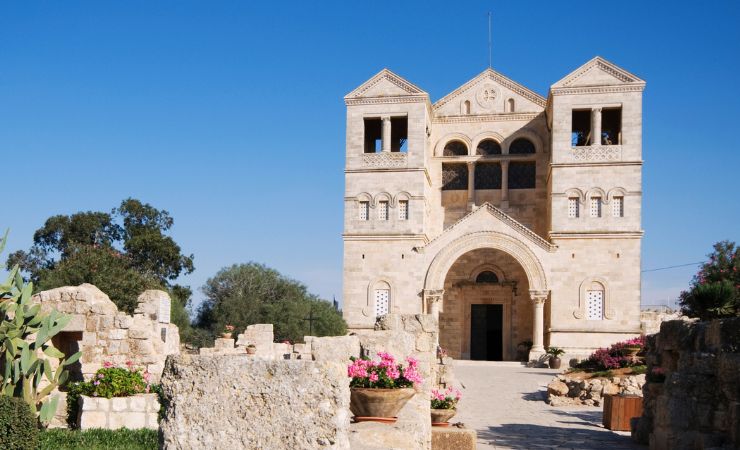
The Church of the Transfiguration stands atop Mount Tabor, the traditional site where Jesus was transfigured before Peter, James, and John. Architect Antonio Barluzzi designed this Franciscan basilica, completed in 1924, featuring two bell towers and incorporating ruins of previous Byzantine and Crusader churches into its striking design.
Mount Tabor rises dramatically from the Jezreel Valley, its summit crowned by the Church of the Transfiguration. This architectural masterpiece, designed by Antonio Barluzzi and completed in 1924, commemorates the biblical Transfiguration of Jesus. The church combines Byzantine and Romanesque elements, with twin towers representing Moses and Elijah. The site holds profound significance for the Holy Land pilgrims, who have venerated this location for over 1,600 years as the place where Jesus was transformed before his disciples.
Location
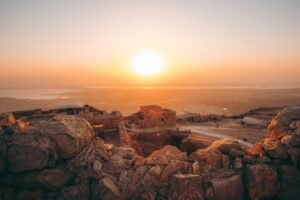
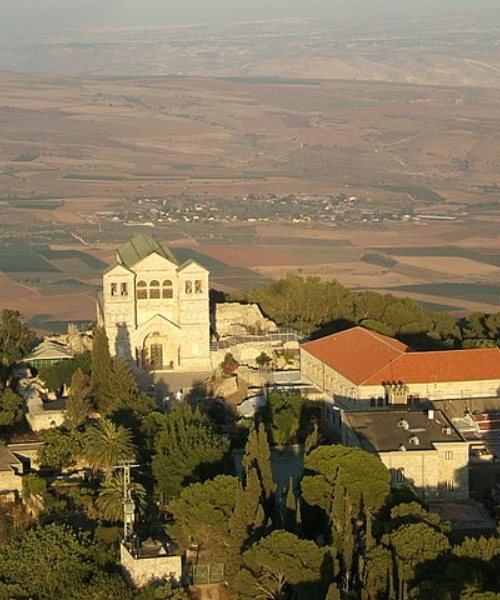
The Church of the Transfiguration sits atop Mount Tabor in the Lower Galilee region of Israel. This mountain rises 588 meters above sea level from the Jezreel Valley, located approximately 18 kilometers west of the Sea of Galilee and 9 kilometers east of Nazareth. The church occupies the summit within the Franciscan monastery complex, reached by a winding road that ascends through pine and olive groves.
Biblical Context of the Transfiguration of Jesus
The Church of the Transfiguration commemorates the event where Jesus revealed his divine glory to three disciples on a high mountain. The New Testament records this transformative moment in Matthew 17:1-9, Mark 9:2-8, and Luke 9:28-36. According to the Gospels, Jesus took Peter, James, and John up the mountain six days after foretelling his death and resurrection. There, his appearance changed dramatically, his face shining like the sun and his clothes becoming brilliant white. Moses and Elijah appeared alongside him, representing the Law and the Prophets. While Mount Tabor’s identification with the Transfiguration developed in Christian tradition by the 4th century, the Gospels themselves describe only a “high mountain apart.”
After six days Jesus took with him Peter, James, and John the brother of James, and led them up a high mountain by themselves. There he was transfigured before them. His face shone like the sun, and his clothes became as white as the light.
Matthew 17:1-9
The Work of Master Architect Antonio Barluzzi
Antonio Barluzzi received the commission to design the Church of the Transfiguration in 1912, but World War I delayed construction until 1919. The Italian architect, known as the “Architect of the Holy Land,” had already established his reputation with the Church of All Nations in Jerusalem. His vision for Mount Tabor drew from extensive study of Byzantine architecture, particularly the Church of St. Simeon Stylites in northern Syria, while incorporating Romanesque elements that would complement the sacred landscape. Construction began in 1919, and completed by 1924. Recent archaeological research excavations during construction revealed foundations of previous Byzantine and Crusader churches, which Barluzzi carefully integrated into his design.
Architectural Style
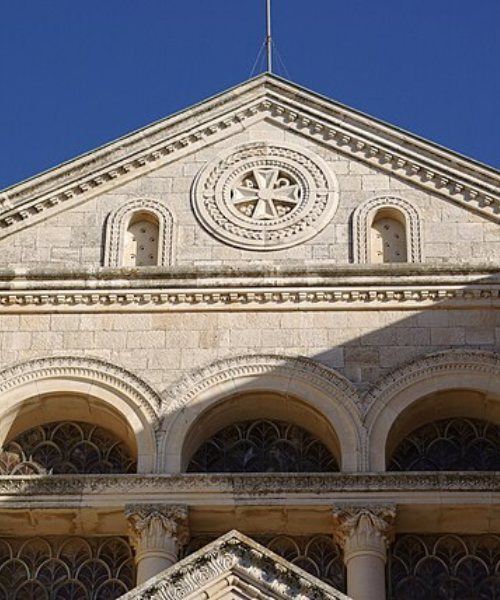
The Church’s design draws inspiration from the Byzantine style, particularly the Church of St. Simeon Stylites in northern Syria, and incorporates Romanesque elements. Its facade is divided into three sections:
- A central portico with a single entrance, adorned with a Corinthian-capitalized arch and a gable.
- Two imposing twin towers flank the central entrance, rising three stories high and also crowned with gables. The towers hold profound symbolic meaning in Christian theology. The northern tower represents Moses, the lawgiver who received the Ten Commandments, while the southern tower honors Elijah, the prophet who ascended to heaven in a chariot of fire. Both figures appeared alongside Jesus during the Transfiguration, making their architectural representation particularly significant. The church bells ring from the southern tower, their sound carrying across the Jezreel Valley below.
Interior Layout
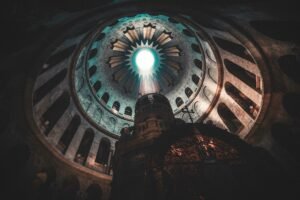
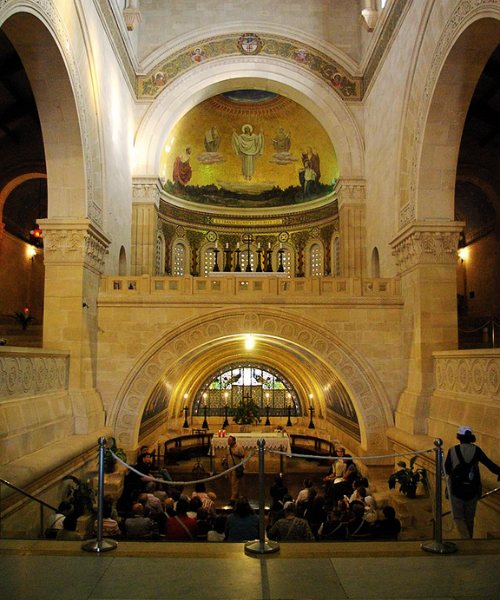
The interior of the Church of Transfiguration is divided into three naves by massive Romanesque-style columns supporting arches and a light floor above.
- Originally, Barluzzi intended the church roof to be made of translucent alabaster panels to allow as much light as possible into the interior, symbolizing the divine light of the Transfiguration. However, this alabaster roof could not be made watertight. The ceiling was eventually crafted from pine wood that is covered with a common, non-translucent copper roof.
- A central feature of the upper basilica is the magnificent golden mosaic of the Transfiguration itself, positioned high above the main altar in the apse. It depicts Christ, radiant and dressed in white, with Moses holding the tablets of the Covenant to his left and Elijah casting off his cloak to his right. On the Feast of the Transfiguration, celebrated on August 6th, a glass plate set into the floor directs sunlight to illuminate this golden mosaic, symbolizing the divine light.
- The Church of Transfiguration also includes two side apses in the main hall. One is dedicated to the Holy Spirit, represented by a dove, and the other to God the Father, symbolized by an eye within a triangle. Together with the crypt dedicated to Jesus (the Son), these three mosaics evoke the Most Holy Trinity.
- The Church houses three grottoes that have been described as representing the three tabernacles that Peter wished to build for Jesus, Moses, and Elias. Moreover, there are two chapels located in the towers at the west front of the church: the Chapel of St. Elias and the Chapel of Moses. The Chapel of Moses features a mosaic pavement with crosses, signifying its construction prior to 422 when Emperor Theodosius II prohibited the representation of crosses in mosaic pavements.
The Crypt
Crusader-era stone steps descend from the main altar to the crypt, where visitors encounter the bedrock of Mount Tabor through protective glass panels. This lower level serves as a bridge between past and present, incorporating stone fragments from Byzantine and Crusader churches into its walls. A modern altar of rough-hewn local stones stands within the remains of an ancient apse, while overhead, a barrel-vaulted ceiling displays continuous mosaics depicting four pivotal moments in salvation history.
The Catholic Complex on Mount Tabor
The Church of the Transfiguration anchors a comprehensive Franciscan complex that serves pilgrims from around the world. The monastery, begun in 1873 and expanded over subsequent decades, features a distinctive clock tower that has become a landmark visible from the surrounding valleys. Its stone construction matches the church’s architectural style, creating visual harmony across the summit plateau.
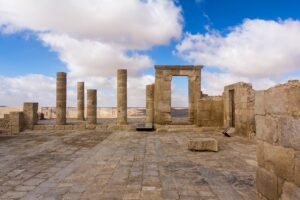
Archaeological remains scattered throughout the complex reveal Mount Tabor’s rich monastic heritage. The ruins of a 12th-century Benedictine monastery include a refectory hall with surviving stone arches and a burial cave system that Byzantine monks likely used for centuries. These ancient stones tell the story of continuous religious devotion, from early Christian hermits to medieval Crusaders to modern Franciscans.
The Franciscan Casa Nova hospice provides essential services for Catholic pilgrims, offering simple accommodations and meals within walking distance of the church. Operated by the Custody of the Holy Land since the 19th century, the hospice maintains the tradition of Christian hospitality that has characterized Mount Tabor for over a millennium. Guest rooms can accommodate small pilgrim groups, while larger visiting parties often stay in nearby Nazareth.
The Descendentibus Chapel, renovated by Barluzzi in his characteristic style, marks the traditional location where Jesus instructed his disciples to remain silent about the Transfiguration until after his resurrection. Located partway down the mountain along the main road, this smaller shrine completes the pilgrimage circuit and provides a place for reflection on the Transfiguration’s deeper meaning in Christian theology.
Practical Information
The Church of the Transfiguration welcomes visitors daily from 8:00 AM to 12:00 PM and 2:00 PM to 5:00 PM (winter) or 6:00 PM (summer). Entry to the church is free, though donations are appreciated for maintenance and restoration work.
Parking is available in a designated area near the monastery entrance, though spaces are limited during peak pilgrimage seasons (Easter, Christmas, and August). Visitors should dress modestly with covered shoulders and knees, as this is an active place of worship. The church is partially wheelchair accessible, with ramps to the main level, though the crypt requires descending stone steps.
Additional Information
Starting 1st Century CE:
- Transfiguration of Jesus: This momentous event, central to Christian belief, occurs on a “high mountain,” widely identified with Mount Tabor.
- Start of Pilgrimage: Mount Tabor becomes a focus of pilgrimage due to its significance in Christian tradition, particularly regarding the Transfiguration.
- First Churches: A tradition starting in the 4th century places the Transfiguration on Mount Tabor.
Late 6th Century CE:
- Three Churches and Bishopric: According to traveler accounts, three churches existed on Mount Tabor’s summit, and it served as a bishop’s seat.
8th Century CE:
- Four Churches and a Monastery: Evidence indicates four churches and a monastery on Mount Tabor.
Early 12th Century CE (Crusader Period):
- 1101 (at the latest): Tancred, Prince of Galilee, establishes a Benedictine monastery on Mount Tabor and fortifies its summit.
- 1113: Benedictine monks on Mount Tabor are massacred by Muslims.
- Shortly after 1113: Structures on the mountain are restored, and the Benedictine presence resumes.
- During the 12th Century: Byzantine church remnants are intentionally cleared, and a Romanesque Crusader church is built in their place, divided into three parts: two chapels for Moses and Elijah, and a crypt symbolizing the Transfiguration.
13th Century CE:
- 1212: Ayyubid Sultan Al-Malik al-Adil constructs a fortress on Mount Tabor.
- 1218: The Ayyubids themselves destroy the fortress on Mount Tabor, fearing its use by Crusaders during the Fifth Crusade.
- 1263: Mamluk ruler Baibars conquers Mount Tabor, destroys structures on its summit, and confiscates it from Christians. The General Chapter in Pisa, under St. Bonaventure, also defines the boundaries of the Province of the Holy Land.
17th Century CE:
- 1620: Franciscans take definitive possession of the site of the Annunciation in Nazareth and are granted Mount Tabor, thanks to Druze Prince Fakhr-al-Din.
19th Century CE:
- 1858: Franciscans on Mount Tabor are finally able to build a small chapel.
- 1873: Construction of a Franciscan monastery on Mount Tabor begins.
- 1877: The convent and Casa Nova are built on Mount Tabor.
- 1819: A permanent community moves into the convent on Mount Tabor.
20th Century CE:
- 1912: The guardian of Mount Tabor begins studies with Giulio Barluzzi for a new shrine, but the Italian-Turkish war halts the project.
- 1919 (October 21): The first stone of the Basilica of the Transfiguration is laid on Mount Tabor, under the direction of the Barluzzi brothers (Antonio Barluzzi).
- 1924: The Church of Transfiguration on Mount Tabor is completed.
- 1964 (January 5): Pope Paul VI visits Mount Tabor, planting an olive tree in the garden of Gethsemane.
Can you drive to the top of Mount Tabor to reach the church?
Yes, visitors can drive to the summit of Mount Tabor via a winding 4.5-kilometer paved road that begins near the village of Daburiyya. The road passes through pine forests and offers scenic views of the Jezreel Valley. Parking is available near the monastery entrance, though spaces fill quickly during religious holidays and summer months.
What is the significance of the twin towers at the Church of the Transfiguration?
The two towers flanking the church entrance represent Moses and Elijah, the Old Testament figures who appeared with Jesus during the Transfiguration. The northern tower is dedicated to Moses, representing the Law, while the southern tower honors Elijah, representing the Prophets. Each tower contains a chapel dedicated to its respective biblical figure.
How much does it cost to visit the Church of the Transfiguration?
Entry to the Church of the Transfiguration is free of charge, though donations are welcomed to support ongoing maintenance and restoration work. Parking on Mount Tabor is also free, but spaces are limited during peak pilgrimage seasons. Guided tours may incur a small fee depending on group size and language requirements.
Sites Nearby the Church of Transfiguration
- Nazareth: Known as the childhood home of Jesus, Nazareth is brimming with religious sites, including the Basilica of the Annunciation and Mary’s Well.
Nein: The Churchat Nein is a quaint church that marks the biblical location where Jesus is believed to have resurrected a widow’s son.
- Mount Precipice: Enjoy breathtaking views from the place where it is traditionally believed is the site where an angry mob attempted to throw Jesus off the cliff after his bold proclamation in the synagogue of Nazareth
- Sea of Galilee: A freshwater lake that holds immense significance as the backdrop for several of Jesus’s miracles, including walking on water the multiplication of the loaves and fishes, and where he delivered the Sermon on the Mount.
- Zippori (Sepphoris) National Park: Just a short drive from Nazareth, this park is home to ancient ruins, including a Roman-era theater. mosaics, and an ancient synagogue.