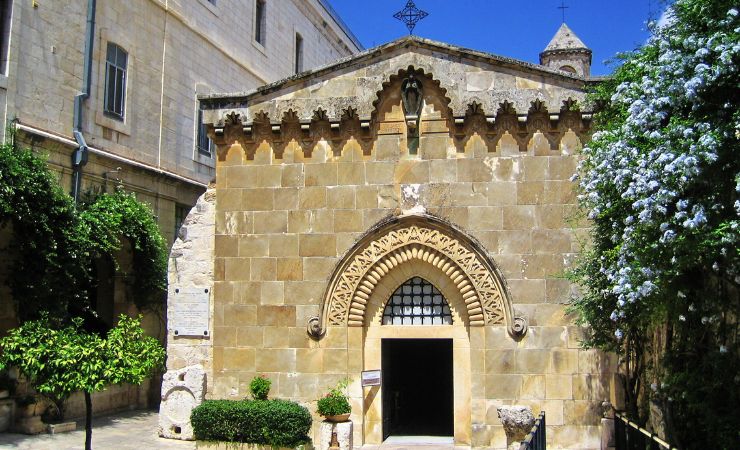
The Church of the Flagellation stands at the Second Station of the Via Dolorosa in Jerusalem's Old City, marking where Jesus was scourged by Roman soldiers according to Christian tradition. This Franciscan church, built in 1929 on ancient foundations, features striking stained glass windows depicting Pilate washing his hands, the flagellation, and Jesus's victory over sin.
Introduction
The Church of the Flagellation marks the traditional site where Jesus Christ was scourged by Roman soldiers before carrying the cross to Golgotha. This sacred sanctuary stands within the Franciscan monastery complex in Jerusalem’s Old City, serving as the Second Station of the Cross on the Via Dolorosa. The modest church contains extraordinary stained-glass windows depicting the Passion narrative and houses centuries of Christian devotion within its medieval stone walls. Archaeological findings beneath nearby structures have revealed Roman flagstones that some scholars identify with the biblical “Gabbatha” where Pontius Pilate presided over Jesus’ trial, adding layers of historical significance to this deeply spiritual site.
Where is the Church of the Flagellation Located?
The Church of the Flagellation occupies a prominent position in the Muslim Quarter of Jerusalem’s Old City, approximately 200 meters from St. Stephen’s Gate, also known as Lions’ Gate. The church forms part of a larger Franciscan monastery complex that includes the adjacent Church of the Condemnation and Imposition of the Cross, both structures sharing the same courtyard on Via Dolorosa. This location places visitors at the traditional Second Station of the Cross, where Christian sites in Israel tradition holds that two pivotal events of the Passion occurred: Jesus’ flagellation by Roman soldiers and his formal condemnation to death by crucifixion. The monastery sits atop what archaeologists believe may be remnants of the ancient Antonia Fortress, the Roman military barracks that once housed Pontius Pilate’s tribunal. Access to the church requires walking through the narrow stone streets of the Old City, with the nearest vehicle access point being the Lions’ Gate parking area.
Biblical Context
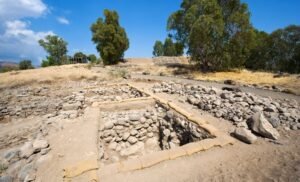
The Church of the Flagellation commemorates the biblical account of Jesus’ scourging as described in all four Gospels, though with varying degrees of detail. According to Matthew 27:26, Mark 15:15, and John 19:1, Pontius Pilate ordered Jesus to be flogged before his crucifixion, a standard Roman practice that typically preceded execution. The Greek term “phragellōo” used in the Gospels refers specifically to the brutal Roman scourging with a flagrum, a whip embedded with metal balls and bone fragments designed to tear flesh. Archaeological excavations conducted beneath the nearby Church of the Condemnation have uncovered an extensive area of Roman flagstones, identified by some researchers as the “Lithostrotos” or stone pavement mentioned in John 19:13. These stones bear ancient markings that may include games played by Roman soldiers, lending credence to the Gospel accounts of the soldiers mocking Jesus before his crucifixion. The discovery of first-century pottery sherds and coins in the area provides additional context for understanding the site’s occupation during the time of Christ, though scholars continue to debate whether this specific location was indeed the praetorium where Pilate held court.
So Pilate, wishing to satisfy the crowd, released for them Barabbas, and having scourged Jesus, he delivered him to be crucified.
A Glimpse into History
The history of Christian veneration at this site spans nearly seventeen centuries, beginning with early pilgrims who identified this area as the location of Jesus’ flagellation and condemnation. During the Byzantine period of the 4th and 5th centuries, the site remained largely undeveloped, with no formal church structure recorded by contemporary pilgrims. The first documented church appeared in the 5th century, though few details of this early structure survive.
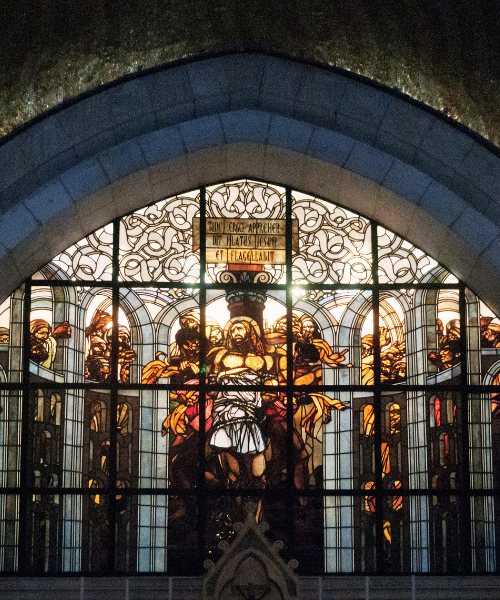
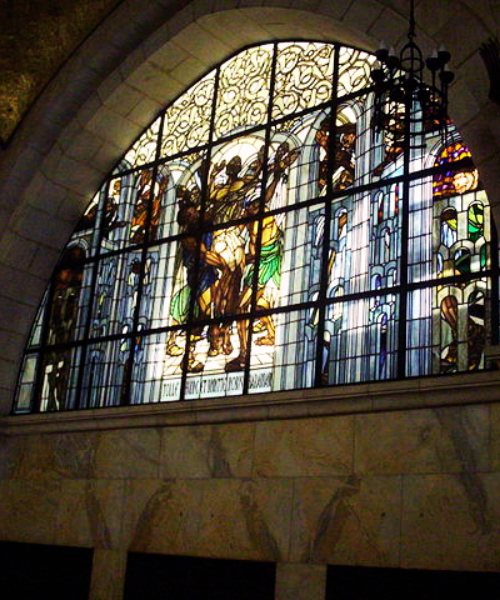
The Franciscan Order, custodians of Catholic holy sites in the Holy Land since 1342, acquired the ruins in 1838 through negotiations with Ottoman authorities. The friars immediately began restoration work, but the structure required complete rebuilding. Italian architect Antonio Barluzzi, renowned for his work on numerous the Holy Land sites throughout Palestine, undertook the current reconstruction between 1927 and 1929. Barluzzi preserved the medieval proportions and Romanesque character while incorporating modern elements such as the stunning stained-glass windows created by A. Cambellotti. These windows depict three scenes from the Passion: Pilate washing his hands, the flagellation itself, and the release of Barabbas. The church also houses a painting by M. Barberis commemorating Saint Paul’s imprisonment in the nearby Antonia Fortress, connecting the site to broader early Christian history in Jerusalem.
Architecture of the Church of the Flagellation
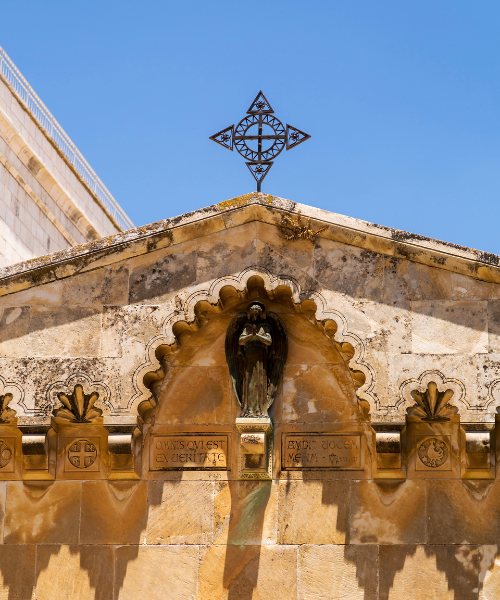
The Church of the Flagellation represents one of Antonio Barluzzi’s most intimate architectural achievements, completed in 1929 as a faithful reconstruction that preserves the medieval character of the original 12th-century Crusader church. Barluzzi’s design philosophy emphasized creating spaces for contemplation and prayer, evident in the church’s deliberately modest proportions and carefully controlled lighting. The structure measures approximately 20 meters in length and 8 meters in width, with walls constructed from the distinctive golden Jerusalem stone that characterizes much of the Old City’s architecture.
The exterior facade showcases Romanesque simplicity, featuring a single entrance framed by a classical arch topped with a rose window that provides natural illumination to the interior.
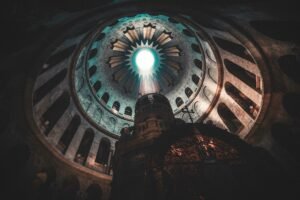
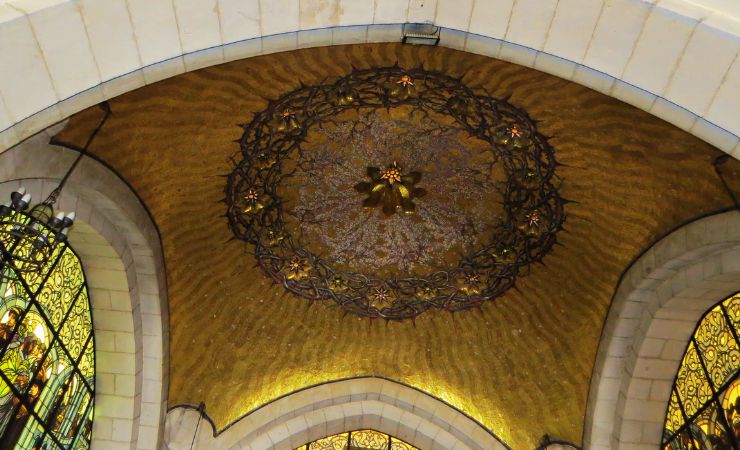
The interior reveals Barluzzi’s mastery of sacred architecture through its single nave design that draws the eye immediately toward the altar. The most striking architectural element is the golden mosaic dome, designed to evoke the crown of thorns placed on Jesus’ head during his torture. This dome incorporates both traditional mosaic work and translucent materials that create a subtle interplay of light throughout the day, shifting from warm golden tones in morning light to deeper amber hues in the afternoon. The dome’s interior surface features intricate patterns that reference both Byzantine and modern decorative traditions, demonstrating Barluzzi’s ability to bridge historical and contemporary design elements.
The church’s three magnificent stained-glass windows, created by Roman artist Angelo Cambellotti, serve as both artistic masterpieces and theological teaching tools. Each window measures approximately 4 meters in height and employs a rich palette of blues, reds, and golds that complement the warm stone interior. The northern window depicts Pontius Pilate washing his hands, capturing the Roman governor’s symbolic attempt to absolve himself of responsibility for Jesus’ fate. The central window behind the altar portrays the flagellation scene itself, with Jesus bound to a column while Roman soldiers carry out the brutal scourging. The southern window shows the release of Barabbas, the criminal freed in Jesus’ place according to the Passover amnesty tradition. Cambellotti’s artistic style combines traditional religious iconography with early 20th-century artistic sensibilities, creating windows that speak to both historical and contemporary viewers.
A painting by M. Barberis depicting Saint Paul’s imprisonment in the Antonia Fortress occupies a place of honor on the south wall, connecting this site to broader narratives of early Christian persecution and witness in Jerusalem. The overall effect creates an atmosphere of reverent simplicity that encourages contemplation of the Passion events commemorated here, fulfilling Barluzzi’s vision of architecture that serves both aesthetic and spiritual purposes.
Practical Information for Visiting
Opening Hours: The Church of the Flagellation is open to visitors daily from 8:00 AM to 12:00 PM and from 2:00 PM to 6:00 PM during summer months (April-September), with slightly shorter afternoon hours in winter (2:00 PM to 5:00 PM). The church closes on Sundays during Mass times (typically 10:00 AM to 11:30 AM) but remains open to quiet visitors during other Sunday hours.
Admission: Entry to the church is free of charge, though donations are gratefully accepted to support ongoing maintenance and the Franciscan community’s work in the Holy Land.
Additional Information
What is the Church of the Flagellation in Jerusalem?
The Church of the Flagellation is a Catholic church in Jerusalem’s Old City that commemorates the traditional site where Jesus Christ was scourged by Roman soldiers before his crucifixion. It serves as the Second Station of the Cross on the Via Dolorosa and forms part of a Franciscan monastery complex. The current church was reconstructed in 1929 by architect Antonio Barluzzi and features stunning stained-glass windows depicting scenes from Jesus’ trial and flagellation.
Where exactly is the Church of the Flagellation located?
The Church of the Flagellation is situated in the Muslim Quarter of Jerusalem’s Old City, approximately 200 meters from Lions’ Gate (St. Stephen’s Gate). It stands within a Franciscan monastery complex on the Via Dolorosa, sharing a courtyard with the adjacent Church of the Condemnation and Imposition of the Cross. The church occupies what may have been part of the ancient Roman Antonia Fortress where Pontius Pilate held court.
What are the opening hours for the Church of the Flagellation?
The Church of the Flagellation is open daily from 8:00 AM to 12:00 PM and from 2:00 PM to 6:00 PM during summer months (April-September). Winter hours run from 8:00 AM to 12:00 PM and 2:00 PM to 5:00 PM. The church closes during Sunday Mass (typically 10:00 AM to 11:30 AM) but remains open for quiet visitors during other Sunday hours. Entry is free, though donations are welcomed.
What can visitors see inside the Church of the Flagellation?
Visitors can admire the church’s distinctive golden mosaic dome designed to resemble the crown of thorns, three magnificent stained-glass windows by Angelo Cambellotti depicting Pilate washing his hands, the flagellation scene, and Barabbas’s release. The church also contains a fresco by M. Barberis commemorating Saint Paul’s imprisonment in the Antonia Fortress. The simple stone interior reflects Barluzzi’s architectural philosophy of creating spaces for contemplation and prayer.
Is the Church of the Flagellation the actual site where Jesus was flogged?
While Christian tradition identifies this as the site of Jesus’ flagellation, historical certainty is impossible to establish. Archaeological excavations have revealed Roman-era flagstones beneath nearby structures that some scholars identify with the biblical “Lithostrotos” where Pilate held court. The site’s connection to the events of Jesus’ Passion relies on centuries of Christian tradition dating back to the early centuries of Christianity, though the exact location remains a matter of scholarly debate.
How long should I plan to visit the Church of the Flagellation?
Most visitors spend 15-30 minutes in the Church of the Flagellation, allowing time to appreciate the stained-glass windows, architectural details, and quiet reflection. The church’s compact size makes it suitable for brief contemplative visits. Many pilgrims visit as part of a complete Via Dolorosa walk, which typically takes 1-2 hours depending on stops at each station. Combined visits to both churches in the Franciscan complex usually require about 45 minutes total.
Nearby Sites
- The Church of the Condemnation and Imposition of the Cross: Situated next to the Church of the Flagellation, it represents the other half of the Second Station of the Cross on the Via Dolorosa. The floor here is believed to conserve several stones of the “Lithostrotos”, the Roman pavement where Jesus was judged.
- St. Anne’s Church and the Pool of Bethesda: About 500 meters away, this site is believed to be the birthplace of the Virgin Mary. The church is renowned for its remarkable acoustics, and the adjacent pools are said to have healing properties.
- Lion’s Gate: Also known as St. Stephen’s Gate, is one of the eight gates of Jerusalem. It is named after the pairs of lions carved on either side of the gate, the symbol of the Mamluk Sultan Baybars. It’s historically significant as the starting point of the Via Dolorosa, the path that Jesus is believed to have walked on his way to crucifixion.
- Mary’s Tomb: Mary’s Tomb, located at the foot of the Mount of Olives, is believed to be the burial place of the Virgin Mary.