The Pater Noster Church stands on the Mount of Olives, built by Helena, mother of Constantine the Great, in the fourth century AD. It marks the traditional site where Jesus taught his disciples the Lord's Prayer. The church features the prayer displayed in over 140 languages on ceramic tiles throughout its walls and courtyards.
Introduction
The Pater Noster Church stands among the most significant Christian pilgrimage sites on Jerusalem’s Mount of Olives. Built over the ruins of a 4th-century Byzantine church commissioned by Helena, mother of Emperor Constantine, this sacred sanctuary commemorates the traditional location where Jesus taught his disciples the Lord’s Prayer. The church displays the prayer in over 140 languages on ceramic tiles, creating a remarkable testament to universal Christian Franciscan sanctuaries in the Holy Land faith. Visitors can explore the ancient cave where early Christians believed Jesus imparted his teachings, along with remnants of Helena’s original church that helped establish the Holy Land’s Christian pilgrimage tradition.
Location
The Pater Noster Church occupies a strategic position on the upper slopes of the Mount of Olives, approximately 800 meters east of the Old City walls. The church sits at an elevation of about 820 meters above sea level, offering panoramic views across Jerusalem’s history to the Temple Mount and Judean Hills. The church location places it within walking distance of other significant Christian sites including the Chapel of the Ascension (200 meters north) and the Church of All Nations at the base of the mount.
Biblical Context
The Pater Noster Church commemorates the biblical tradition that Jesus taught his disciples the Lord’s Prayer on the Mount of Olives. According to Luke 11:1-4 and Matthew 6:9-13, when the disciples requested instruction on prayer, Jesus responded with what became Christianity’s most fundamental prayer. The Mount of Olives served as Jesus’s regular teaching location during his final week in Jerusalem, as recorded in the Gospels. Early Christian pilgrims from the 4th century onward identified this specific site with the prayer instruction, establishing a devotional tradition that spans nearly 1,700 years.
This, then, is how you should pray:
‘Our Father in heaven, hallowed be your name, your kingdom come, your will be done, on earth as it is in heaven.
Give us today our daily bread. And forgive us our debts, as we also have forgiven our debtors. And lead us not into temptation, but deliver us from the evil one.’”
A Glimpse into the History of Pater Noster
The current church is built on the ruins of one of the oldest churches in the holy land.
The Byzantine Era: Helena’s Sacred Legacy
In the early 4th century, Helena, mother of Emperor Constantine, initiated her historic pilgrimage to establish Christianity’s physical presence in the Holy Land. Her construction of the Church of Eleona (from the Greek “eleon,” meaning olive grove) represented one of Christianity’s earliest major building projects in Jerusalem. The original church featured three naves separated by marble columns imported from Constantinople.
The Dark Ages: Silence and Ruin
The Persian invasion of 614 CE devastated Jerusalem’s Christian infrastructure, including the Church of Eleona. When Muslim forces captured the city in 638 CE under Caliph Omar ibn al-Khattab, the damaged church was abandoned rather than rebuilt. For nearly 500 years, the site remained largely forgotten except for occasional visits by Christian pilgrims who left written accounts describing ruined walls and scattered marble fragments. The olive grove gradually reclaimed the sacred space, with ancient trees taking root among the fallen stones.
The Crusader Period: Rekindling the Flame
The Crusader conquest of Jerusalem in 1099 renewed Christian interest in the Mount of Olives sites. Canon Regulars established a small oratory in 1106 among Helena’s ruins, followed by a more substantial church completed in 1152 with funding from Bishop Svend of Viborg in Denmark. The Crusader church featured Romanesque architecture with thick stone walls and rounded arches. Crusader documents record that the site became exclusively associated with the Lord’s Prayer tradition during this period, diverging from Helena’s original focus on the Ascension. Saladin’s forces heavily damaged the structure during the 1187 siege, and the church was finally abandoned after the fall of the Crusader Kingdom in 1291.
The Modern Era: Renewal and Rebirth
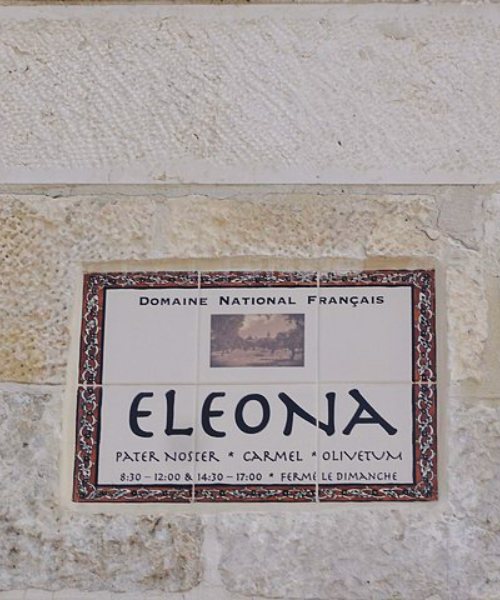
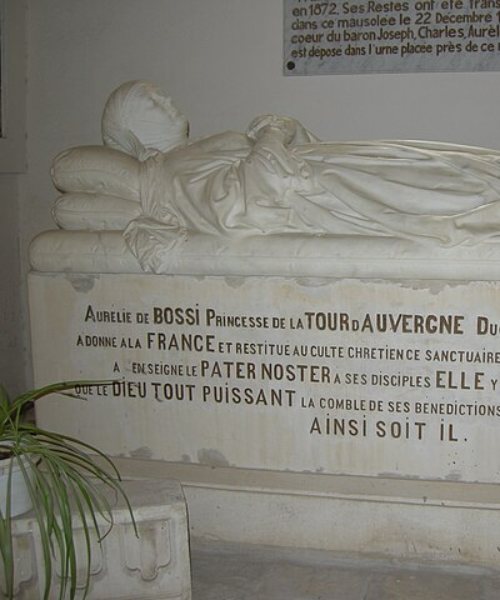
The remarkable resurrection of the Pater Noster Church began with Princess Aurelia Bossi de la Tour d’Auvergne, known as “Orly de Bois,” who purchased the site in 1868. Born to French nobility, she devoted her substantial inheritance to reconstructing the church within a Carmelite monastery she established called the Sanctuary of the Eleona. Construction began in 1915 under the supervision of Italian architect Antonio Barluzzi, but World War I and funding constraints left the project incomplete, which explains the church’s unfinished appearance.
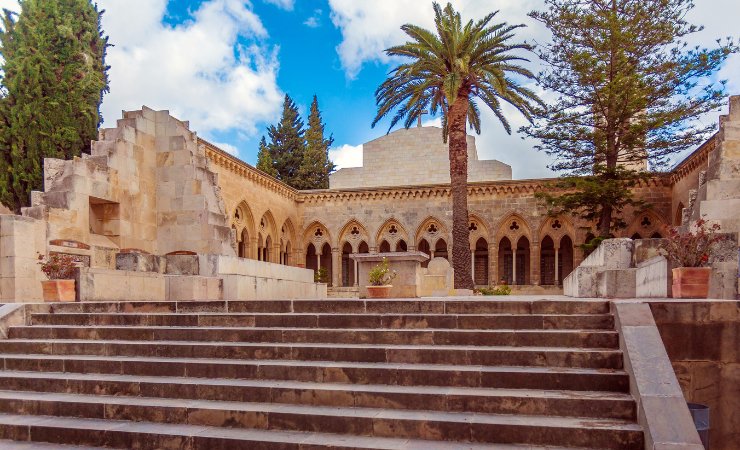
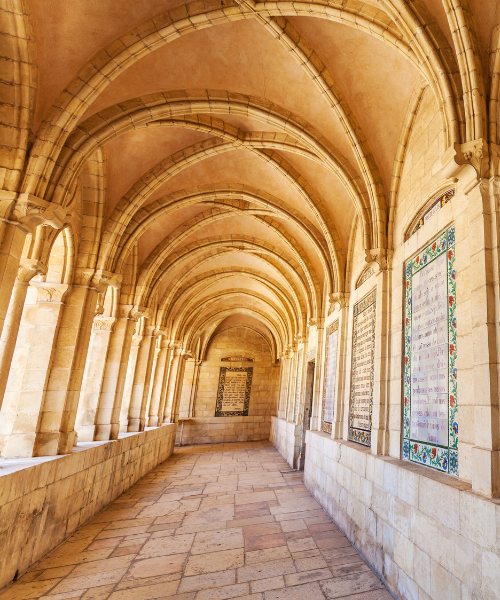
The architecture blends neo-Byzantine elements with modern construction techniques. The building’s most striking feature is its central cloister, modeled after the Campo Santo in Pisa, Italy, measuring 30 by 25 meters. The cloister’s covered walkways contain ceramic plaques displaying the Lord’s Prayer in 143 languages, created by artisans from around the world. Each plaque measures approximately 50 by 40 centimeters and uses traditional ceramic techniques specific to its cultural origin.
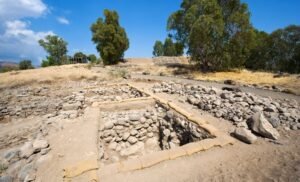
The church preserves substantial portions of Helena’s original Byzantine foundations, visible in the eastern section where 4th-century column bases and mosaic fragments remain exposed. recent archaeological research excavations conducted between 1920-1925 revealed the complete floor plan of Helena’s church and confirmed the location of the sacred cave, now accessible through a modern staircase.
Princess Aurelia died in 1904 before seeing her vision completed, but her devotion earned her burial in the church crypt. Her simple marble tombstone, inscribed in French and Latin, lies beneath the main altar. The Carmelite nuns who maintain the site continue her mission of preserving this intersection of biblical tradition, Byzantine heritage, and modern Christian pilgrimage.
Archeological Finding at Pater Noster
Systematic archaeological investigations at the Pater Noster Church have revealed remarkable continuity of Christian worship spanning 1,700 years, with findings that illuminate both the site’s biblical significance and its architectural evolution.
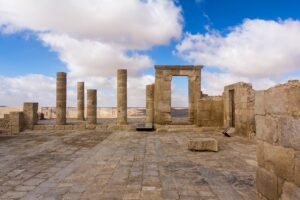
- Byzantine Church Remains: Excavations between 1920-1925 uncovered Helena’s complete 4th-century church foundation, measuring 30 by 15 meters. The original church featured a central nave flanked by two aisles, separated by rows of marble columns with Corinthian capitals imported from Constantinople. Seven intact column bases remain visible in the site courtyard, each measuring 1.2 meters in diameter and bearing distinctive Byzantine craftsmanship. The church floor contained elaborate mosaic work using tesserae (small ceramic and stone pieces) in geometric and Christian symbolic patterns, with fragments still visible beneath protective glass panels.
- The Lord’s Prayer Tablets: The modern cloister displays 143 ceramic plaques, each inscribed with the Lord’s Prayer in different languages and scripts. The collection includes ancient scripts like Aramaic and Coptic alongside modern languages from every continent. Each plaque measures approximately 50 by 40 centimeters and represents traditional ceramic techniques from its cultural origin. Notable examples include Japanese calligraphy on porcelain, Arabic script on Damascus tiles, and Celtic lettering on Irish pottery. missionaries and cultural attachés from around the world contributed these plaques between 1920-1960, making this one of the most comprehensive multilingual religious displays globally.
- The Sacred Cave: The natural limestone cave beneath the church, measuring approximately 8 by 6 meters with a vaulted ceiling 3 meters high, contains archaeological evidence of continuous veneration since the 4th century. Byzantine-era Christian symbols carved into the cave walls include crosses, fish (ichthys), and Greek inscriptions invoking Christ’s name. Oil lamp niches cut into the rock walls held lighting for early Christian pilgrims during prayer services. Medieval Crusader graffiti overlays some Byzantine markings, indicating continuous use throughout the Crusader period (1099-1291). Modern stairs installed in 1925 provide visitor access while protecting the ancient cave environment through climate control systems.
Practical Information (General information: Check for opening times before you go)
The Pater Noster Church welcomes visitors year-round with specific visiting guidelines and amenities designed to accommodate both individual pilgrims and tour groups.
Opening Hours: The church operates Monday through Saturday from 8:30 AM to 12:00 PM and 2:30 PM to 5:00 PM. Sunday hours are 2:30 PM to 5:00 PM only, as morning hours are reserved for religious services. The site closes on major Christian holidays including Christmas, Easter, and Good Friday.
Admission: Entry costs 10 NIS (approximately $3 USD) for adults, with children under 12 admitted free.
Additional Information
What is the Pater Noster Church and why is it significant?
The Pater Noster Church is a Christian pilgrimage site on the Mount of Olives where tradition holds that Jesus taught his disciples the Lord’s Prayer. Built over the ruins of a 4th-century Byzantine church commissioned by Helena, mother of Emperor Constantine, it represents one of Christianity’s oldest sacred sites in Jerusalem. The church displays the Lord’s Prayer in over 140 languages and preserves a sacred cave where early Christians believed Jesus imparted his teachings.
How much does it cost to visit Pater Noster Church (2026)?
Admission to the Pater Noster Church costs 10 NIS (approximately $3 USD) for adults, with children under 12 entering free.
Can I see the Lord’s Prayer in different languages at the church?
Yes, the church’s cloister features 143 ceramic plaques displaying the Lord’s Prayer in different languages and scripts from around the world. The collection includes ancient scripts like Aramaic and Coptic alongside modern languages from every continent. Each plaque represents traditional ceramic techniques from its cultural origin, creating a remarkable testament to universal Christian faith.
Is the sacred cave beneath Pater Noster Church accessible?
The sacred cave can be visited, but access requires descending stone steps, making it inaccessible to wheelchairs or mobility devices. The limestone cave measures approximately 8 by 6 meters and contains Byzantine-era Christian symbols carved into the walls. For visitors unable to access the cave, photographs and virtual tours are available in the visitor center.
What archaeological remains can visitors see at the church?
Visitors can observe substantial remains of Helena’s 4th-century Byzantine church, including seven intact marble column bases with Corinthian capitals in the courtyard. Fragments of elaborate mosaic floors are visible beneath protective glass panels. The site also preserves Crusader-era modifications and incorporates natural cave formations that have been continuously venerated since early Christian times.
How do I get to Pater Noster Church from central Jerusalem?
The church is accessible by car or taxi via the Mount of Olives Road, taking 15-20 minutes from central Jerusalem. Public buses stop along the main Mount of Olives Road, requiring a short uphill walk through olive groves to reach the church. The site sits at 820 meters above sea level, approximately 800 meters east of the Old City walls.
Nearby Sites
- Chapel of the Ascension: Just a short walk from the Pater Noster Church, the Chapel of the Ascension is believed to mark the spot where Jesus ascended into heaven. This small, round chapel is one of the oldest Christian sites on the Mount of Olives.
- Garden of Gethsemane and the Church of All Nations: Located at the foot of the Mount of Olives. It is believed to be the place where Jesus prayed and his disciples slept the night before his crucifixion. The garden is home to ancient olive trees and the Church of All Nations.
- Dominus Flevit Church: This Roman Catholic church is situated on the western slope of the Mount of Olives. Its name means “The Lord Wept” in Latin. The church is shaped like a teardrop, symbolizing the tears of Christ.
- Tomb of the Prophets: This ancient burial site is located on the western slope of the Mount of Olives and is believed to be the resting place of several Old Testament prophets.