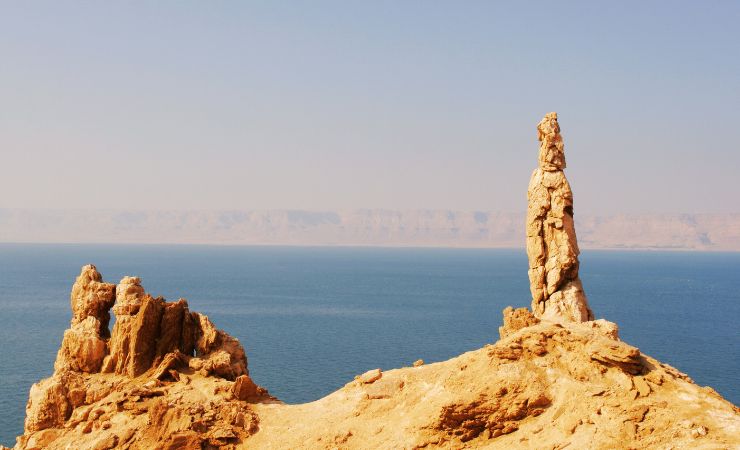
Lot's Wife Pillar is a natural salt formation near the Dead Sea's southern shore, traditionally identified as the biblical figure who turned into salt after looking back at Sodom and Gomorrah's destruction. The pillar stands on Mount Sodom, where erosion has carved distinctive salt columns from the mountain's geological layers over thousands of years.
Near the Dead Sea, the formation known as Lot’s Wife Pillar is a natural salt formation traditionally linked to the biblical story of Lot’s wife, who, according to the Book of Genesis, was transformed into a pillar of salt when she looked back at the destruction of Sodom and Gomorrah. This striking geological formation has captivated pilgrims, archaeologists, and tourists for centuries, serving as a physical reminder of one of the Bible’s most memorable cautionary tales.
Location
Lot’s Wife Pillar stands on Mount Sodom, a distinctive salt mountain along the southwestern shores of the Dead Sea in Israel. Mount Sodom extends approximately 11 kilometers in length and 2 kilometers in width, composed primarily of rock salt (halite) formations dating back millions of years to ancient sea evaporation. The mountain rises about 200 meters above the Dead Sea’s surface, reaching a height of 190 meters below sea level. The pillar itself measures approximately 7 meters in height and is visible from several vantage points along Route 90, the main highway that runs along the Dead Sea’s western shore. GPS coordinates place the formation at 31.0333° N, 35.3897° E, making it easily accessible for both guided tours and independent visitors.
Biblical context
Background to Lot’s Flight from Sodom
The story of Lot’s family begins in the city of Sodom, a place described in the Bible as rife with corruption and immorality. Lot, the nephew of Abraham, had chosen to settle in Sodom due to its fertile plains (Genesis 13:10-12). Archaeological evidence suggests that several ancient settlements existed in the southern Dead Sea region during the Middle Bronze Age (circa 2000-1500 BCE), coinciding with the traditional dating of Abraham and Lot. Over time, the cities of Sodom and Gomorrah became synonymous with sin, drawing the attention of God, who decided to destroy them as a form of divine judgment.
In Genesis 18, we see Abraham intercede on behalf of Sodom, pleading with God to spare the city if even ten righteous individuals could be found within its walls. However, the cities were beyond redemption. Angels, sent to warn Lot, arrived in Sodom and were welcomed into his home. The townspeople surrounded Lot’s house, demanding that the visitors be handed over to them, an act that demonstrated the city’s complete moral collapse. Lot refused, protecting the strangers at great personal risk, even offering his own daughters to appease the mob.
The angels revealed the impending destruction and urged Lot to gather his family and flee immediately. They warned:
Do not look back or stop anywhere in the plain. Flee to the mountains, or you will be swept away!
Genesis 19:26
The Transformation of Lot’s Wife
Lot, his wife, and two daughters escaped the city just as God rained down sulfur and fire, obliterating Sodom and Gomorrah. The biblical account describes a catastrophic event that transformed the entire Jordan Valley region. Recent geological studies suggest that seismic activity and possible meteor impacts may have contributed to destruction events in the ancient Near East, providing scientific context for the biblical narrative.
As they fled, Lot’s wife famously disobeyed the angels’ command and turned back to look at the burning cities. Genesis 19:26 records that she became a pillar of salt. This act has been interpreted as a symbol of disobedience, attachment to sin, or a longing for the past, leaving her eternally frozen in her moment of hesitation. Jewish commentaries from the Talmudic tradition suggest her action represented an inability to fully separate from the corrupt society she was leaving behind, while Christian interpretations often focus on the consequences of looking backward when God calls one forward.
The Geology of Mount Sodom and the Formation of the Pillar
The Lot’s Wife pillar of salt is a natural rock salt formation with a striking resemblance to a human figure, and its creation is tied to the unique geology and history of Mount Sodom. Unlike other salt formations shaped primarily by gradual erosion, this pillar’s origin is linked to a dramatic geological event that occurred thousands of years ago.
Around 4,000 years ago, a powerful earthquake in the region caused the roof of a salt cave to collapse. The pillar now known as “Lot’s Wife” was left standing as a remnant of this cave system. Over millennia, wind and rain sculpted the column into its current form. The process of salt dissolution and erosion, aided by the arid climate, continues to shape the structure, though its core remains remarkably intact due to the region’s extreme dryness.
The Science Behind the Pillar’s Formation
- Salt Cave Formation and Collapse: Mount Sodom is honeycombed with caves due to the solubility of salt. Groundwater and occasional rainfall dissolve sections of the mountain, forming hollow chambers. The Lot’s Wife pillar is believed to have been part of such a cave before the earthquake caused its roof to collapse, leaving this isolated column standing.
- Salt Plasticity: Halite, the main component of Mount Sodom, is highly malleable under pressure and temperature changes. This plasticity allows the mountain to continuously reshape itself through a process called salt diapirism, contributing to unique formations like Lot’s Wife.
- Environmental Impact: The hyper-arid climate of the Dead Sea region, combined with its hypersaline environment, limits the speed of erosion, preserving the pillar for millennia. Wind and sporadic rainstorms continue to refine its contours, but the formation remains relatively stable due to minimal precipitation in the area.
What Can Be Seen
Visitors to the Lot’s Wife pillar can observe this remarkable geological formation up close, standing approximately 7 meters tall with distinctive layered salt deposits clearly visible in its structure. The pillar displays various shades of white, cream, and pale gray, created by different mineral concentrations within the salt rock.
The Pillar Formation: The main attraction displays a humanoid silhouette when viewed from certain angles, with what appears to be a head, torso, and draped clothing carved by natural erosion processes.
Salt Crystal Formations: The surrounding area features numerous smaller salt formations, caves, and crystalline deposits that showcase the ongoing geological processes shaping Mount Sodom.
Panoramic Views: From the pillar’s location, visitors enjoy expansive views of the Dead Sea, the Judean Desert, and the mountains of Jordan across the water.
Cave Systems: Several accessible salt caves near the pillar demonstrate how the formation was created, with visible evidence of roof collapse and natural sculpting.
Practical Information
The Lot’s Wife pillar is accessible year-round as it stands on public land adjacent to Mount Sodom. The best viewing times are early morning or late afternoon when the lighting enhances the pillar’s distinctive features and temperatures are more comfortable for walking.
Basic facilities include a small parking area that accommodates tour buses and private vehicles. No restrooms or refreshment stands are available at the site itself, though these can be found at nearby Ein Bokek resort area, approximately 10 kilometers north.
Additional Information
How did Lot’s Wife pillar of salt form naturally?
The Lot’s Wife pillar of salt formed when an ancient salt cave’s roof collapsed during an earthquake approximately 4,000 years ago, leaving this column standing as a remnant. Over millennia, wind and rain sculpted the pure halite formation into its current human-like shape while the arid Dead Sea climate preserved its structure.
Can you climb or touch the Lot’s Wife pillar of salt?
Visitors are not permitted to climb the Lot’s Wife pillar of salt due to both safety concerns and preservation efforts. The salt formation is fragile and climbing could cause damage to this significant geological and religious landmark. Viewing and photography from designated areas around the base are encouraged.
What is the biblical significance of Lot’s wife turning to salt?
According to Genesis 19:26, Lot’s wife was transformed into a pillar of salt when she disobeyed the angels’ command and looked back at the burning cities of Sodom and Gomorrah. Jewish and Christian traditions interpret this as a symbol of attachment to sin, disobedience to divine command, or the consequences of longing for a corrupt past rather than moving toward salvation.
How tall is the Lot’s Wife pillar and what does it look like?
The Lot’s Wife pillar of salt stands approximately 7 meters (23 feet) tall and 3 meters wide at its base. When viewed from certain angles, the natural erosion has carved the formation into a distinctly human silhouette with what appears to be a head, torso, and draped clothing, creating an eerie resemblance to a person frozen in time.
Is there scientific evidence for the destruction of Sodom and Gomorrah?
Archaeological investigations in the southern Dead Sea region have uncovered evidence of ancient settlements that were suddenly abandoned around 2000-1500 BCE. Some researchers point to geological evidence of seismic activity and possible meteor impacts in the region, though the connection to the biblical cities remains a subject of scholarly debate.
What other biblical sites are near Lot’s Wife pillar?
The Dead Sea region contains numerous biblical sites within driving distance, including Masada (Herod’s fortress), Ein Gedi (where David hid from Saul), Qumran (where the Dead Sea Scrolls were discovered), and various locations associated with Jesus’s baptism. The area serves as a natural biblical archaeology corridor along the Dead Sea’s western shore.
When is the best time to visit Lot’s Wife pillar of salt?
The optimal times to visit are early morning (6:00-9:00 AM) or late afternoon (4:00-6:00 PM) when temperatures are cooler and lighting conditions enhance the pillar’s appearance. Winter months (November-March) offer the most comfortable weather, while summer visits should be planned for dawn or dusk to avoid dangerous heat levels.
How do I get to the Lot’s Wife pillar from Jerusalem or Tel Aviv?
From Jerusalem, take Route 1 east toward the Dead Sea, then Route 90 south for approximately 90 kilometers to the marked access road near Ein Bokek. From Tel Aviv, drive southeast via Route 6 to Route 31, then Route 90 south, totaling about 150 kilometers. The site is clearly marked with brown tourist signs along Route 90.
Nearby Sites
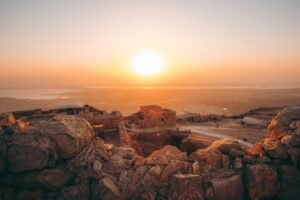
- Masada: An ancient fortress atop a plateau, offering historical insights and panoramic views of the Dead Sea.
- Ein Gedi Nature Reserve: A lush oasis featuring waterfalls, diverse flora, and fauna, ideal for hiking and exploration.
- Ein Gedi Synagogue: A stunning testament to ancient Jewish life, adorned with intricate mosaics.
- Qumran Caves: The archaeological site where the Dead Sea Scrolls were discovered, shedding light on ancient Jewish history.