Tel Dan is an archaeological site in northern Israel identified with the biblical city of Dan. The site spans from the Neolithic period to the Roman era and features remains of ancient gates, a Canaanite mud-brick arch, and the famous Tel Dan Stele, which contains the earliest known reference to the House of David outside the Bible.
The Tel Dan archaeological site, known in Arabic as Tell el-Qāḍī, represents one of northern Israel’s most significant excavations, revealing a rich history that spans from the Neolithic period to the Roman era. This remarkable site has been identified with the biblical city of Dan, and before that, the Canaanite city of Laish, making it a crucial window into ancient Near Eastern civilization.
Location
The Tel Dan archaeological site is located at the foot of Mount Hermon. This strategic location marks the source of the Dan River, the largest tributary of the Jordan River, which flows year-round with crystal-clear waters from underground springs. The site sits at an elevation of 200 meters above sea level, providing natural advantages for both defense and water access that made it attractive to successive civilizations.
The History of Tel Dan
The earliest human activity at the Tel Dan archaeological site dates back to the Neolithic era, around 5000 BCE, marking it as one of the oldest known settlements in the region. Excavations have revealed pottery fragments and stone tools indicating continuous occupation through the Chalcolithic period (4000-3200 BCE). During the Middle Bronze Age (circa 1900–1500 BCE), the city, then known as Laish, emerged as a major fortified Canaanite urban center controlling vital trade routes between Mesopotamia and the Mediterranean coast. Laish is mentioned in ancient Egyptian records, including the conquest list of Pharaoh Thutmose III in the 15th century BCE, and in the Mari Letters from Mesopotamia, underscoring its prominence in the ancient Near East.
According to the biblical narrative in Judges 18, the Israelite tribe of Dan, seeking new territory after facing pressure from the expanding Philistines in their southern territories, migrated northward and captured Laish around 1200 BCE, renaming it Dan in honor of their ancestor. Archaeological evidence supports a significant cultural shift during this period, with changes in pottery styles, domestic architecture, and settlement patterns indicating a transition from Canaanite to Israelite occupation. The peaceful nature of pre-conquest Laish, described in Judges as “living in security, in the manner of the Sidonians, quiet and unsuspecting,” reflects its isolated but prosperous status.
Under Israelite control, the Tel Dan archaeological site became a vital northern border city within the kingdom. King Jeroboam I (reigned circa 931-910 BCE) established a major cultic center there, erecting a golden calf to prevent his subjects from traveling to Jerusalem for worship, as detailed in 1 Kings 12:28–30. This religious innovation made Dan one of the two primary sanctuaries of the northern kingdom of Israel, alongside Bethel, fundamentally altering its role from a border fortress to a pilgrimage destination.
Biblical Context
The Tel Dan archaeological site holds considerable importance within the biblical narrative, frequently referenced in contexts that illustrate its religious, strategic, and political roles within ancient Israel. The city of Dan is mentioned 21 times in the Hebrew Bible: Genesis (once), Joshua (once), Judges (twice), First Samuel (once), Second Samuel (5 times), First Kings (4 times), Second Kings (once), First Chronicles (once), Second Chronicles (twice), Jeremiah (twice), and Amos (once). The phrase “from Dan to Beersheba” appears multiple times as a way to describe the full extent of the Israelite kingdom, with Dan representing the northernmost boundary.
Here are a few key examples:
Abraham and the Pursuit to Dan
The Tel Dan archaeological site first appears in the Bible as the northernmost landmark reached by Abraham during his pursuit of kings who had kidnapped his nephew Lot. This early reference establishes the area’s ancient significance:
“When Abram heard that his relative had been taken captive, he called out the 318 trained men born in his household and went in pursuit as far as Dan.” (Genesis 14:14, NIV)
This biblical reference indicates the site’s strategic location as a known geographic boundary of early Canaan, though scholars debate whether this refers to the later city of Dan or an earlier settlement at the same location. The narrative suggests the area was already recognized as a significant landmark by the time Genesis was compiled.
Conquest by the Tribe of Dan
Originally known as Laish, the site was conquered by the tribe of Dan after migrating from their initial territory in the south due to Philistine pressure. The narrative emphasizes the city’s peaceful nature and isolation before its capture, as recorded in biblical literature:
“Then they took what Micah had made, and his priest, and went on to Laish, against a people at peace and secure. They attacked them with the sword and burned down their city… They rebuilt the city and settled there. They named it Dan after their ancestor Dan, who was born to Israel—though the city used to be called Laish.” (Judges 18:27-29, NIV)
This marked a significant shift as the tribe of Dan firmly established itself in the region, renaming the site after their patriarch.
Jeroboam’s Golden Calves
The religious significance of the Tel Dan archaeological site was cemented when Jeroboam I, king of the Northern Kingdom of Israel, erected one of two golden calves to deter his people from making pilgrimages to Jerusalem. This political-religious decision fundamentally altered Dan’s role:
“After seeking advice, the king made two golden calves. He said to the people, ‘It is too much for you to go up to Jerusalem. Here are your gods, Israel, who brought you up out of Egypt.’ One he set up in Bethel, and the other in Dan. And this thing became a sin…” (1 Kings 12:28-30, NIV)
This event transformed Tel Dan into a prominent religious site, albeit controversial, illustrating the political and spiritual tensions of ancient Israel.
Prophetic Condemnations
The establishment of the calf cult at Dan drew criticism from the prophets, notably Amos, who denounced the practices at Dan and predicted divine judgment against such idolatry. The prophet’s words reflect the ongoing religious controversy:
“Those who swear by the sin of Samaria—who say, ‘As surely as your god lives, Dan,’… they will fall, never to rise again.” (Amos 8:14, NIV)



Excavation History and Archeological Findings
Excavation History
Archaeological interest in Tell el-Qāḍī, identified as biblical Dan in 1838 by American scholar Edward Robinson during his groundbreaking survey of Palestine, began in the 19th century. However, systematic excavations at the Tel Dan archaeological site did not commence until 1966. These excavations were initially undertaken as a rescue operation by the Israel Department of Antiquities and Museums under the direction of Avraham Biran, following reports of illegal digging and antiquities theft at the site. In 1974, Biran moved to the Hebrew Union College, bringing the Tel Dan project under the auspices of the Nelson Glueck School of Biblical Archaeology.
Biran led an unprecedented 33 seasons of excavations at the site, from 1966 until the end of the 1990s, making it one of the longest-running archaeological projects in Israel. Over these decades, seven distinct areas were excavated on the mound, primarily along its perimeter to create a comprehensive stratigraphic sequence. The excavation team employed cutting-edge techniques for the time, including detailed photographic documentation, computer-assisted recording systems, and interdisciplinary collaboration with botanists, zoologists, and geologists. While numerous preliminary reports and articles have been published by Biran and his colleagues, the final reports for the Iron Age II period are still awaited, though archaeological journals continue to publish ongoing research from the site. Nevertheless, the extensive excavations have revealed a wealth of information about the city’s long history spanning over 4,000 years.
Archaeological Finds
The excavations at Tel Dan have unearthed significant remains from various periods, attesting to its importance over millennia. Key archaeological discoveries include:
- Massive Bronze Age Ramparts: Evidence of substantial fortifications dating back to the Middle Bronze Age.
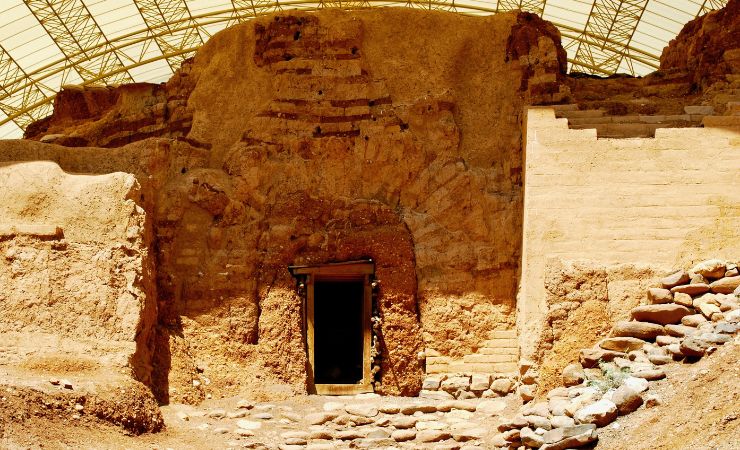
- Intact Mud-Brick Gate of the Middle Bronze Age: Featuring three complete arches spanning 2.5 meters each, this impressive structure dates to the 18th-19th century BCE and is considered one of the oldest complete arches in the world, predating Roman architectural innovations by nearly two millennia. The gate, popularly referred to as “Abraham’s Gate,” includes guard chambers and a sophisticated drainage system.
- Middle Bronze Age Tombs and Burials: Providing insights into burial practices and material culture of the period.
- Late Bronze Age “Mycenaean Tomb”: I A unique burial chamber containing imported Mycenaean pottery, indicating direct connections to the Aegean world and Mediterranean-wide trade networks during the 14th-13th centuries BCE.
- Rich Stratum of the Early Iron Age: Associated with the Israelite settlement period, yielding numerous grain storage pits, hundreds of ceramic vessels showing new cultural influences, evidence of copper and iron metallurgical activity, and distinctive four-room house architecture typical of Israelite settlements.
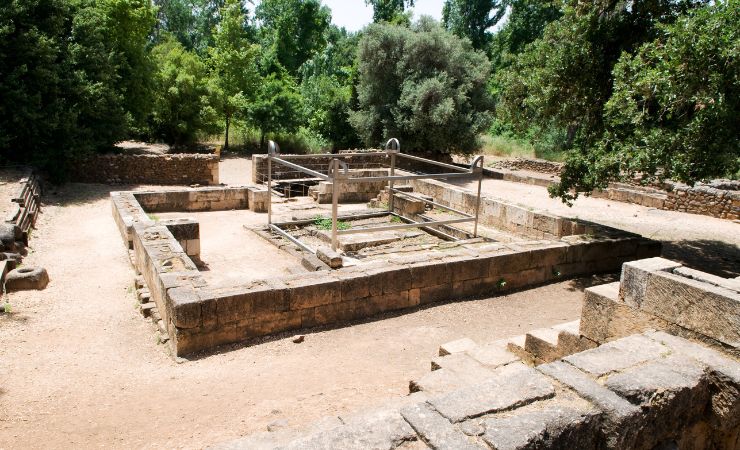
- Sacred Precinct (High Place): Dating to the Iron Age II, this 18×18 meter cultic platform with associated buildings suggests Dan’s role as a major religious center. Excavations revealed multiple construction phases, bronze and iron ritual objects, incense stands, and complete ceramic vessels used in religious ceremonies during the 9th-8th centuries BCE.
- Series of Gate Complexes Dating to the Iron Age II: Particularly massive six-chambered gate systems reflecting the city’s strategic importance during the 9th and 8th centuries BCE. The outer gate is one of the largest Iron Age gates ever discovered.
- Iron Age Inscriptions on Vessels: Eight Iron Age inscriptions have been discovered on vessels, providing evidence of literacy and the use of Hebrew and Aramaic at Tel Dan. Some of these inscriptions contain personal names, some with potential Yahwistic elements, and possible Phoenician influences.
- Assyrian Residence: Evidence of Assyrian presence and administration at Tel Dan following its probable conquest in the late 8th century BCE.
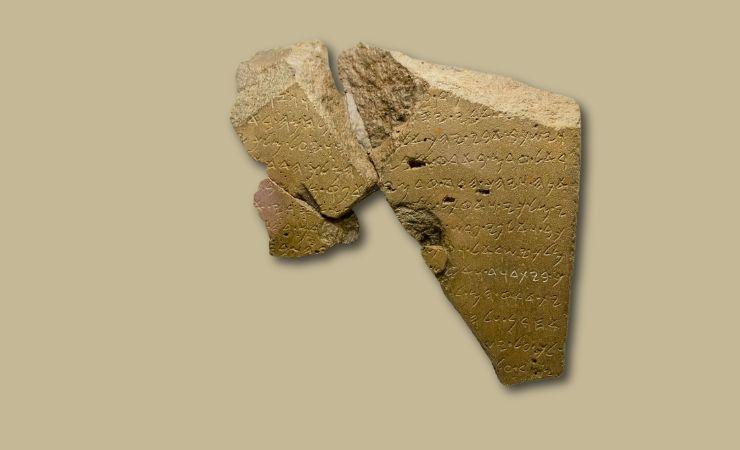
The Tel Dan Stele and the Mention of David
One of the most remarkable discoveries at the Tel Dan archaeological site is the Tel Dan Stele, a fragmentary black basalt inscription slab that revolutionized biblical archaeology. The main fragment was found on July 21, 1993, by Gila Cook, a surveyor working with the excavation team, embedded in an 8th-century BCE wall bordering a piazza outside the outer gate in Area A. According to accounts from the excavation, Cook noticed ancient letters on a partially buried stone while completing site measurements. When she showed the inscription to excavation director Avraham Biran, he initially struggled to see the letters clearly in the afternoon light. Upon realizing the inscription’s profound archaeological significance, Biran reportedly exclaimed quietly in perfect English, “Oh my God!” Two smaller fragments were discovered the following year in 1994 during continued excavation of the same area.
The inscription, carved in Old Aramaic script and generally dated to the second half of the 9th century BCE, is believed by most scholars to have been erected by Hazael, the powerful king of Aram-Damascus who dominated the region during this period. The stele originally stood over 1.5 meters tall and was likely placed in a prominent location before being deliberately broken and reused as building stones. The preserved text, consisting of 13 fragmentary lines, boasts of military victories over “the king of Israel” and “the king of the House of David,” corresponding to the biblical accounts of Aramean campaigns against both the northern kingdom of Israel and the southern kingdom of Judah.
The mention of “bytdwd” (ביתדוד), or “House of David,” in line 9 of the main fragment has generated intense scholarly debate. The initial interpretation by the excavators, Avraham Biran and Joseph Naveh, identified this as a reference to the biblical dynasty of David. This interpretation is supported by many archaeologists and biblical scholars and is considered by some as the first historical evidence of King David outside of the Hebrew Bible.
However, this reading has faced skepticism, with some scholars suggesting alternative interpretations of “bytdwd,” such as a place name or a deity. Despite these debates, the prevailing view among many is that the Tel Dan Stele provides nearly contemporary corroboration for the existence of King David and his dynasty in the 9th century BCE. The stele’s shattering is thought to have occurred during the first half of the 8th century BCE, possibly signifying the recapture of Tel Dan by the Kingdom of Israel.
Practical Information
The Tel Dan archaeological site operates as part of the Tel Dan Nature Reserve, managed by the Israel Nature and Parks Authority. The site is open daily from 8:00 AM to 4:00 PM (closes at 3:00 PM on Fridays and holiday eves), with extended summer hours until 5:00 PM from April through September. Adult admission costs 28 NIS (approximately $8 USD), with reduced rates of 14 NIS for students, seniors over 62, and children ages 5-17. Group discounts are available for parties of 20 or more visitors.
Additional Information
Pre-Iron Age:
- c. 7000 years ago: First settlement at Tel Dan.
- c. 2700 BCE: The first city is established at Tel Dan (initially known as Laish or Leshem).
- c. 1750-1550 BCE (Middle Bronze Age II B-C): The Canaanite city of Laish is well-fortified with an earthen rampart (10-15 meters high with a stone core) and a mud-brick arched gate (“Gate of Three Arches”). The city enjoys trade with Mesopotamia and Sidon and is mentioned in Egyptian Execration Texts and Mari documents as a source of tin.
- Mid-15th Century BCE (Late Bronze Age I): Thutmose III of Egypt conquers Laish. Mycenaean culture influences are present, including a Mycenaean tomb.
- 13th Century BCE (Late Bronze Age II B): A smaller settlement exists.
- 12th Century BCE (Iron Age IA): Granary pits and metalworking indicate a developing copper industry, possibly linked to early Israelite settlement. Philistine pottery is also found.
- 11th Century BCE (Iron Age IA): Destruction layer.
Iron Age:
- 10th Century BCE (Iron Age IB – Iron Age IIA): After the Israelite conquest, the tribe of Dan, having trouble in the south with the Philistines, migrates north, conquers Laish, and renames it Dan after their ancestor. Jeroboam I, the first king of the Northern Kingdom of Israel after the split from Judah, builds cultic sites in Bethel and Dan, including placing one of the two golden bulls in Dan to rival Jerusalem as a religious center.
- 9th Century BCE (Iron Age IIB):Ben-Hadad I of Aram Damascus is bribed by Asa, King of Judah, to break his alliance with Baasha, King of Israel, and attacks Israelite cities, including Ijon and Dan.
- Ahab, King of Israel, expands the cultic complex at Dan.
- The Tel Dan Stele is erected by an Aramean king, likely Hazael of Aram Damascus, commemorating a victory over the Kingdom of Israel. The stele mentions the killing of Joram, King of Israel, and Ahaziah, King of the “House of David” (Kingdom of Judah). This event aligns with the biblical account of Jehu’s revolt, although the stele attributes the killings to the Aramean king.
- Early 8th Century BCE (Iron Age IIB):Jeroboam II, King of Israel, adds steps to the cultic platform at Dan.
- The Tel Dan Stele is likely destroyed and its fragments used as building material, possibly by Jehoash, King of Israel, who fought against Aram and recaptured cities taken by Hazael.
- c. 750 BCE (Iron Age II C): Tel Dan is destroyed by a large fire, likely during the Assyrian conquest.
- 733/732 BCE: Tiglath-Pileser III of Assyria conquers the Northern Kingdom of Israel. While Abraham Biran suggested this as the end of Dan, there is no direct biblical or Assyrian record of Dan’s destruction at this time.
- Late 8th Century BCE (Iron Age IIB): Level associated with the Assyrian conquest contains a room of altars, bronze and silver scepter head, and Paleo-Hebrew, Phoenician, and Aramaic inscriptions.
- Late 8th/7th Century BCE (Iron Age II C): Destruction layer associated with the Babylonian destruction.
Post-Iron Age:
- Persian-Hellenistic Period (4th-1st Centuries BCE): The cultic site at Dan is revived. A bilingual (Greek and Aramaic) inscription “To the god who is in Dan” testifies to its continued religious importance.
- Roman Period (1st-4th Centuries CE): Dan is conquered during the revolt against the Romans and subsequently destroyed, leading to its abandonment. The main settlement shifts to Banias.
- Mamluk and Early Ottoman Periods (15th-16th Centuries CE): Possible farmstead or small village exists at the site, with remains of a small cemetery found.
- 1917: Arthur Hjelt visits Tell el-Kadi (Tel Dan) and describes its abundant water source and lush vegetation, recognizing its potential for archaeological excavation and hoping for a Finnish expedition. World War I interrupts his plans.
- 1963: A brief test excavation is conducted by Z. Yeivin on behalf of the Department of Antiquities and Museums.
- 1966 onwards: Extensive archaeological excavations begin at Tel Dan, primarily led by Abraham Biran, initially for the Department of Antiquities and Museums and later for the Nelson Glueck School of Biblical Archaeology of Hebrew Union College-Jerusalem. Over 33 seasons of excavation take place.
- 1979: The Canaanite arched gate is discovered.
- July 21, 1993: Gila Cook, a surveyor for the excavation team, discovers the first fragment (A) of the Tel Dan Stele.
- 1994: Two more fragments (B1 and B2) of the Tel Dan Stele are discovered by the excavation team led by Abraham Biran in the gate area.
- Since the late 20th Century: The Tel Dan Stele is displayed at the Israel Museum in Jerusalem.
- 2001: The Israel Nature and Parks Authority, with assistance from the World Monuments Watch, erects a shelter over the Canaanite gate to protect it.
What makes the Tel Dan archaeological site significant for biblical archaeology?
The Tel Dan archaeological site is globally significant because it yielded the Tel Dan Stele, which contains the first extra-biblical historical reference to King David and the “House of David.” The site also preserves one of the world’s oldest intact arched gates dating to the Middle Bronze Age, and extensive remains that span over 4,000 years of continuous occupation from Neolithic times through the Roman period.
How long does it take to visit Tel Dan archaeological site?
A typical visit to the Tel Dan archaeological site takes 2-3 hours to see all the major features including Abraham’s Gate, the sacred precinct, the Iron Age gate complex, and the nature trails. Visitors who want to explore the full trail system and read all the interpretive signs may need 3-4 hours. The site combines archaeological ruins with beautiful nature walks along the Dan River springs.
Can you see the actual Tel Dan Stele at the archaeological site?
The original Tel Dan Stele is housed at the Israel Museum in Jerusalem for conservation reasons. However, the Tel Dan archaeological site features an excellent replica stele displayed near the location where the original fragments were discovered. The visitor center also includes detailed exhibits about the stele’s discovery, translation, and historical significance.
What biblical events are connected to the Tel Dan archaeological site?
The Tel Dan archaeological site connects to several biblical narratives, including Abraham’s pursuit to Dan in Genesis 14:14, the conquest of Laish by the tribe of Dan recorded in Judges 18, and Jeroboam I’s establishment of golden calf worship described in 1 Kings 12:28-30. The site also relates to various prophetic condemnations, particularly in the books of Amos and Jeremiah.
When is the best time to visit the Tel Dan archaeological site?
The best time to visit the Tel Dan archaeological site is during spring (March-May) and fall (September-November) when temperatures are mild and the surrounding vegetation is at its most beautiful. Winter visits are pleasant but can be muddy after rain. Summer visits are possible but require early morning arrival due to heat and humidity near the springs.
Nearby Sites
- Banias Nature Reserve (Caesarea Philippi) – A lush nature reserve featuring scenic waterfalls, ancient ruins, and the famous grotto associated with the Greek god Pan.
- Nimrod Fortress – A medieval Crusader-era fortress perched dramatically atop the Golan Heights, offering spectacular panoramic views.
- Mount Hermon – Israel’s highest peak, popular for hiking in summer and skiing in winter, providing breathtaking landscapes year-round.
- Hula Valley Nature Reserve – Renowned for birdwatching, this reserve hosts thousands of migrating birds, including cranes, pelicans, and storks.