The Cardo Maximus was the main north-south street in Roman and Byzantine Jerusalem, serving as the city's central thoroughfare. Built initially in the 2nd century CE and expanded in the 6th century, this colonnaded avenue connected major city gates and remains partially preserved in the Jewish Quarter today.
The Cardo Maximus in Jerusalem served as the main north-south thoroughfare during the Roman and Byzantine periods. The word Cardo derives from the Latin meaning “hinge” or “axis,” reflecting its role as the central spine around which ancient Jerusalem organized itself. Remnants of this historic street stretch approximately 600 meters through what is now the Jewish Quarter of the Old City, running from the Damascus Gate in the north toward the Zion Gate in the south.
Historical Context
The Cardo Maximus in Jerusalem originated during Emperor Hadrian’s transformation of the destroyed city into Aelia Capitolina following the Bar Kokhba Revolt (132-135 CE). After suppressing the Jewish rebellion with devastating consequences, Hadrian completely redesigned Jerusalem according to Roman urban planning principles. The new city featured a classical grid pattern with two major thoroughfares: the north-south Cardo Maximus and the east-west Decumanus Maximus, which intersected near what is now the Muristan area. This initial Roman Cardo ran approximately 1.2 kilometers from the Damascus Gate southward, serving both civilian traffic and military patrols in this strategically important frontier city.
The street underwent significant expansion during the Byzantine period, particularly under Emperor Justinian I (527-565 CE). As archaeological evidence from recent excavations confirms, Justinian extended the Cardo southward to connect the Church of the Holy Sepulchre with his monumental Nea Church near today’s Jewish Quarter.



Excavation Background
Archaeologist Nahman Avigad conducted the most significant excavations of the Cardo Maximus between 1970 and 1981, focusing on a 600-foot stretch of the southern section within the Jewish Quarter. His team uncovered approximately 60 Byzantine architectural elements, including limestone column bases, fluted columns, and elaborately carved Corinthian capitals. The discovery that many column bases remained in their original positions while other architectural features had been reused in later Crusader and medieval structures provided crucial evidence for the street’s continuous occupation and adaptation over centuries.
A pivotal finding emerged when excavators discovered that this Byzantine section of the Cardo Maximus was constructed directly on bedrock, with no underlying Roman construction. This evidence, combined with pottery analysis and architectural studies, strongly suggests that Emperor Justinian ordered the southern extension’s construction as part of his massive building campaign in Jerusalem. The excavations also revealed the remains of the Nea Church, Justinian’s ambitious project to rival the Church of the Holy Sepulchre. One original column from the Nea still stands adjacent to King David‘s Tomb and the Room of the Last Supper, providing a tangible connection between the Byzantine street and its monumental destinations.
Open-air Section of the Cardo
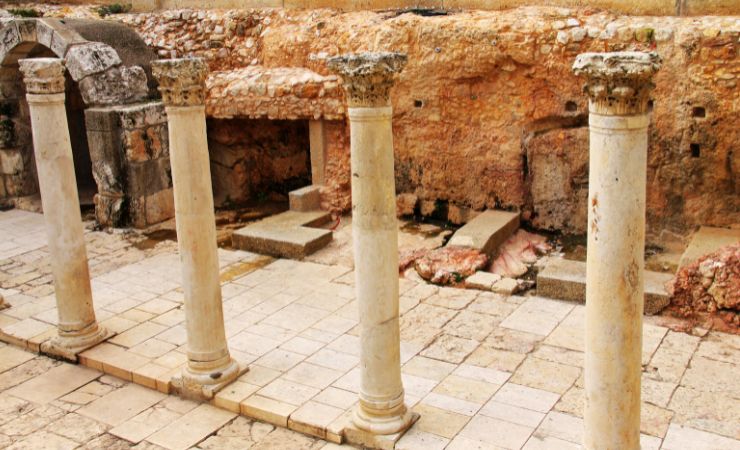
The reconstructed open-air section extends approximately 150 meters through the Jewish Quarter, situated 2.5 meters below modern street level where visitors can walk along the original paving stones. The excavated thoroughfare reveals its impressive original width of 22 meters (73 feet), divided into three distinct sections: a central 12-meter roadway flanked by two covered colonnades. The surviving limestone columns, spaced precisely 5.77 meters apart, originally stood about five meters high and supported roofed porticoes that protected merchants and pedestrians from Jerusalem’s seasonal weather. Archaeological evidence shows that shops and workshops lined these covered walkways, creating a bustling commercial environment beneath the protective colonnades.
Shopping Arcade
Modern restoration has transformed a portion of the ancient Cardo into a covered shopping arcade, where contemporary stores occupy spaces built within Crusader-era vaults and chambers. These medieval structures were themselves constructed atop the Byzantine foundations, creating a layered archaeological environment where visitors can shop for souvenirs while walking through 1,500 years of Jerusalem’s commercial history. The arcade maintains the atmosphere of an ancient Roman street market while serving modern tourists and residents.

A large and colorful wall mural
The expansive wall mural along the excavated Cardo recreates the street’s appearance during the Byzantine period, complete with merchants, pilgrims, and architectural details based on archaeological findings. Artist Dan Carmel included three notable figures in the composition: former Jerusalem mayor Teddy Kollek, archaeologist Nachman Avigad (who led the excavations), and a self-portrait. The mural also features a modern-dressed boy in the lower right corner, creating a time-traveler effect that connects ancient and contemporary Jerusalem. This artistic interpretation helps visitors visualize the bustling commercial and religious activity that once filled these colonnaded walkways.

The Madaba Map Jerusalem
The Cardo displays a faithful reproduction of the famous Madaba Map, a 6th-century mosaic floor discovered in a Jordanian church in 1896. This Byzantine cartographic masterpiece depicts Jerusalem from an aerial western perspective, showing the Cardo Maximus as a straight colonnade-lined avenue running from the Damascus Gate to the Zion Gate area. The map’s remarkable accuracy includes architectural details like red tile roofs, wooden structural elements, and column spacing that excavations later confirmed. Archaeologists used this ancient map as a guide for locating and reconstructing the Cardo’s remains, demonstrating how medieval religious art can serve as precise historical documentation for modern archaeological projects.

Sites Along the Cardo Maximus
- Damascus Gate: The northern terminus of the Cardo Maximus, this imposing Ottoman-era gate built on Roman and Crusader foundations marks the main entrance from the north. Archaeological excavations beneath the current structure have revealed remains of Hadrian’s triple-arched Roman gate.
- Station 7 of the Via Dolorosa: This traditional stopping point along the Christian pilgrimage route marks where Jesus allegedly fell for the second time while carrying the cross. The station lies close to the ancient Cardo’s path through the Old City.
- Junction with Decumanus Maximus (Muristan Area): The intersection of Jerusalem’s two main Roman streets created the city’s central forum, later occupied by the Muristan complex. This area served as the commercial and administrative center of Aelia Capitolina, housing temples, basilicas, and market facilities.
- Ecce Homo Arch and “Lithostratos” (Eastern Forum/Struthion Pool Pavement): This triple-arched Roman gateway near the Struthion Pool marked the entrance to Hadrian’s secondary eastern forum. The well-preserved stone pavement beneath the Convent of the Sisters of Zion provides insight into Roman paving techniques and urban design.
- Crusader Period Markets: Medieval Crusaders constructed three covered markets (the Goldsmith’s Street, Spice Street, and Butcher’s Street) directly over the Byzantine Cardo’s foundations between 1099-1187 CE, adapting the ancient street grid for their commercial needs.
- Nea Church (Byzantine): The substantial remains of Justinian’s 6th-century basilica once stood as Jerusalem’s largest church, connected to the Holy Sepulchre via the Cardo’s southern extension. Modern excavations have revealed the church’s impressive apse and foundation walls.
- Zion Gate: The southern terminus of the extended Byzantine Cardo, this gate provided access to Mount Zion and the early Christian communities that developed outside the Roman city walls.
Practical Infomation
The Cardo Maximus archaeological site is accessible through the Jewish Quarter of Jerusalem’s Old City. Entry to the open-air excavated section is free of charge and available 24 hours daily, though the covered shopping arcade operates during standard business hours
Additional Information
Roman Period and the Founding of Aelia Capitolina
- Pre-135 CE: Emperor Hadrian makes the decision to establish a Roman city in Jerusalem with a pagan temple on the Temple Mount, leading to the construction of Aelia Capitolina.
- 130 CE: Emperor Hadrian visits Jerusalem during his imperial tour.
- 132-135 CE: The Bar Kokhba Revolt, a second Jewish uprising, occurs in Judea, with devastating effects on the local Jewish population.
- 135 CE: The Bar Kokhba Revolt ends. The Roman city of Aelia Capitolina is founded on the ruins of Jerusalem by Emperor Hadrian. The city is intended as a Roman colony, a traditional settlement for veterans, and an armed outpost of Rome.
- After 135 CE (Founding of Aelia Capitolina): Roman administration takes over the city’s lands. A significant portion of the population consists of Roman army veterans and settlers from the western empire. A temple dedicated to Venus is built in the Muristan area, possibly near or next to a temple of Jupiter. Two main streets, the Cardo and Decumanus, are laid out as part of the typical Roman grid plan. The Cardo Maximus (main north-south street) runs from Damascus Gate to Zion Gate, and a second eastern Cardo (Cardo Orientalis) runs from Damascus Gate to Dung Gate (later extending to Siloam).
Byzantine Period
- 324 CE – 337 CE (Constantine’s Reign): Emperor Constantine, who became Emperor of the Roman Empire in 324 CE, builds in Jerusalem, including the Church of the Holy Sepulchre. There is a debate about whether he extended the Cardo.
- 527 CE – 565 CE (Justinian’s Reign): Emperor Justinian builds a large church, “Nea Church,” in the area of today’s “Batey Mahaseh.” The Byzantine Cardo in the Jewish Quarter is dated to his period (6th century CE), connecting the Church of the Holy Sepulchre with the Nea Church. This Cardo is confirmed by Byzantine pottery and Corinthian capitals found in excavations, and its construction follows the Byzantine foot (32 cm) rather than the Roman foot (29.6 cm). Important religious processions occur along this axis.
Later Periods
- 614 CE – 629 CE: Persian control of Jerusalem lasts until 629 CE.
- Crusader Period: The Cardo, as Jerusalem’s main longitudinal street, continues to serve this function. It branches into three Crusader market streets (Goldsmiths Street, Spices Street, Butchers Street) near the Church of the Holy Sepulchre. This market, called “Goods Sale Market,” is built on the Cardo’s alignment. Today, the names of the two streets on either side are Jewish Street and Chabad Street.
What is the difference between the Roman and Byzantine Cardo Maximus?
The Roman Cardo was built around 135 CE as part of Hadrian’s Aelia Capitolina and ran from Damascus Gate southward approximately 1.2 kilometers. The Byzantine extension, constructed under Emperor Justinian in the 6th century, extended the street further south to connect the Church of the Holy Sepulchre with the new Nea Church, using different architectural measurements and more elaborate colonnaded design.
Can you walk on the original Cardo Maximus stones?
Yes, visitors can walk along sections of the original Byzantine paving stones in the excavated open-air area of the Jewish Quarter. The ancient street surface lies about 2.5 meters below the current street level and features the original limestone paving blocks installed during the 6th century.
Why is the Jerusalem Cardo Maximus significant for Christianity?
The Byzantine-era Cardo Maximus served as a ceremonial processional route connecting Christianity’s two most important churches in Jerusalem: the Church of the Holy Sepulchre and Justinian’s Nea Church. Christian pilgrims used this colonnaded avenue for religious processions, making it a central axis of Byzantine Christian Jerusalem.
What happened to the Cardo during the Crusader period?
Crusader builders constructed three parallel covered markets directly over the Byzantine Cardo’s foundations between 1099-1187 CE. These markets (Goldsmith’s Street, Spice Street, and Butcher’s Street) adapted the ancient street’s alignment for medieval commercial use, with many of their stone vaults still visible today in the modern shopping arcade.
What architectural elements from the original Cardo can still be seen?
Visitors can observe original limestone column bases still in their ancient positions, reconstructed columns, carved Corinthian capitals, and sections of the original paving stones. The excavations also revealed parts of the ancient drainage system and shop foundations that lined the colonnaded walkways.